
 English
  French

Visual Reasoning takes artificial intelligence beyond simple visual recognition, enabling systems to interpret the full context of a scene. Built on advanced vision models, it supports intelligent automation for tracking, subject detection, scene description, and real-time analysis. This technology is applied across sports, education, healthcare, industrial, and corporate environments, enhancing workflows and supporting more informed decision-making. Through collaboration with specialized AI partners, the project delivers practical tools for system integrators and video professionals.
PTZOptics, among the first manufacturers to recognize the potential of Visual Reasoning, integrates and promotes this technology within its PTZ camera lineup.
Until a few years ago, PTZOptics cameras—despite their advanced technology—were essentially “passive” devices, capturing what was in front of them without understanding it. The introduction of Advanced Auto-Tracking, now a standard feature across the latest PTZOptics generation, marked the first step toward intelligent automation: cameras began to autonomously follow a subject, reducing the need for manual control and ensuring smoother movement.
Visual Reasoning takes this concept significantly further, fundamentally redefining the paradigm. The camera no longer just tracks—it interprets what it sees, understands the scene, and responds based on context. How does it achieve this?
First, Visual Reasoning represents the natural evolution of AI applied to imaging: it enables systems to understand relationships, motion, visual priorities, and structured information, transforming a simple video stream into actionable data that can trigger automated processes. This capability unlocks advanced functions such as scene description, contextual recognition, graphic element reading, and event-based triggers driven by what the camera “understands.” In ProAV and broadcast environments, this translates into faster workflows, reduced manual intervention, and more consistent production quality—even with smaller teams.
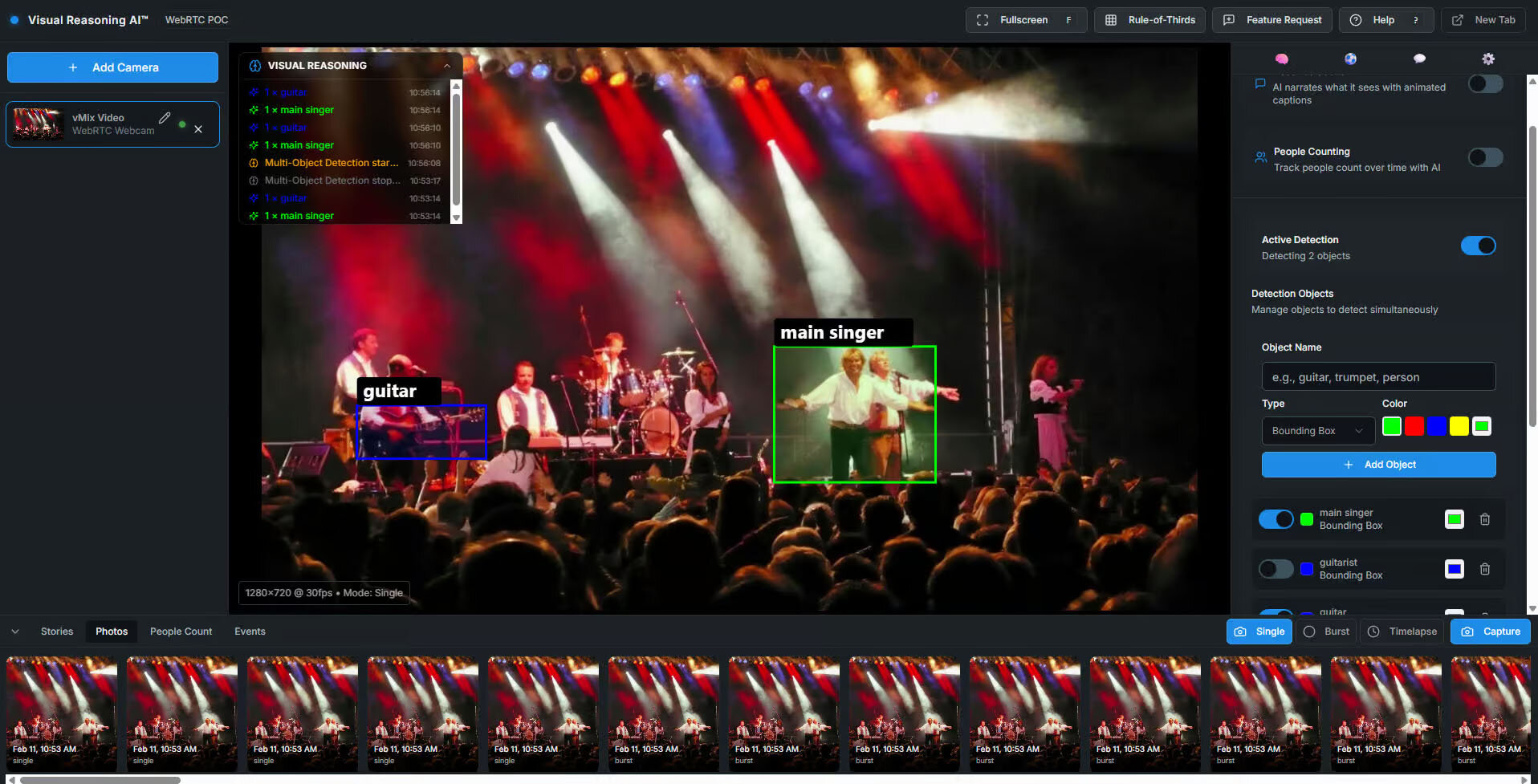
At its core lies the Vision Language Model (VLM), capable of answering natural-language queries about what the camera is capturing, such as: “Is there someone at the podium? How many people are in the front row? Identify the individual wearing a red jacket.” There is no need for model training or predefined classes—simply describe what needs to be tracked.
Visual Reasoning overcomes the limitations of traditional techniques: face tracking fails when subjects turn away, motion tracking follows any movement indiscriminately, markers require dedicated hardware, and trained models cannot recognize unseen objects. With VLM, however, the camera can track anything that can be described.
This is where PTZOptics plays a key role. As a manufacturer specialized in PTZ cameras for a wide range of applications, it is ideally positioned to integrate these technologies directly into its devices. PTZ cameras are, in fact, the first to fully benefit from AI capable of interpreting scenes—enabling more natural tracking, improved automatic framing, recognition of relevant subjects, and context-driven automation.
As Paul Richards, Chief Revenue Officer of PTZOptics, states: “you can automate what cameras do based on what they see”—a concept that perfectly encapsulates the essence of Visual Reasoning.
PTZOptics and the new visual reasoning initiative: AI that turns video into action
AI-Powered defect detection for manufacturing
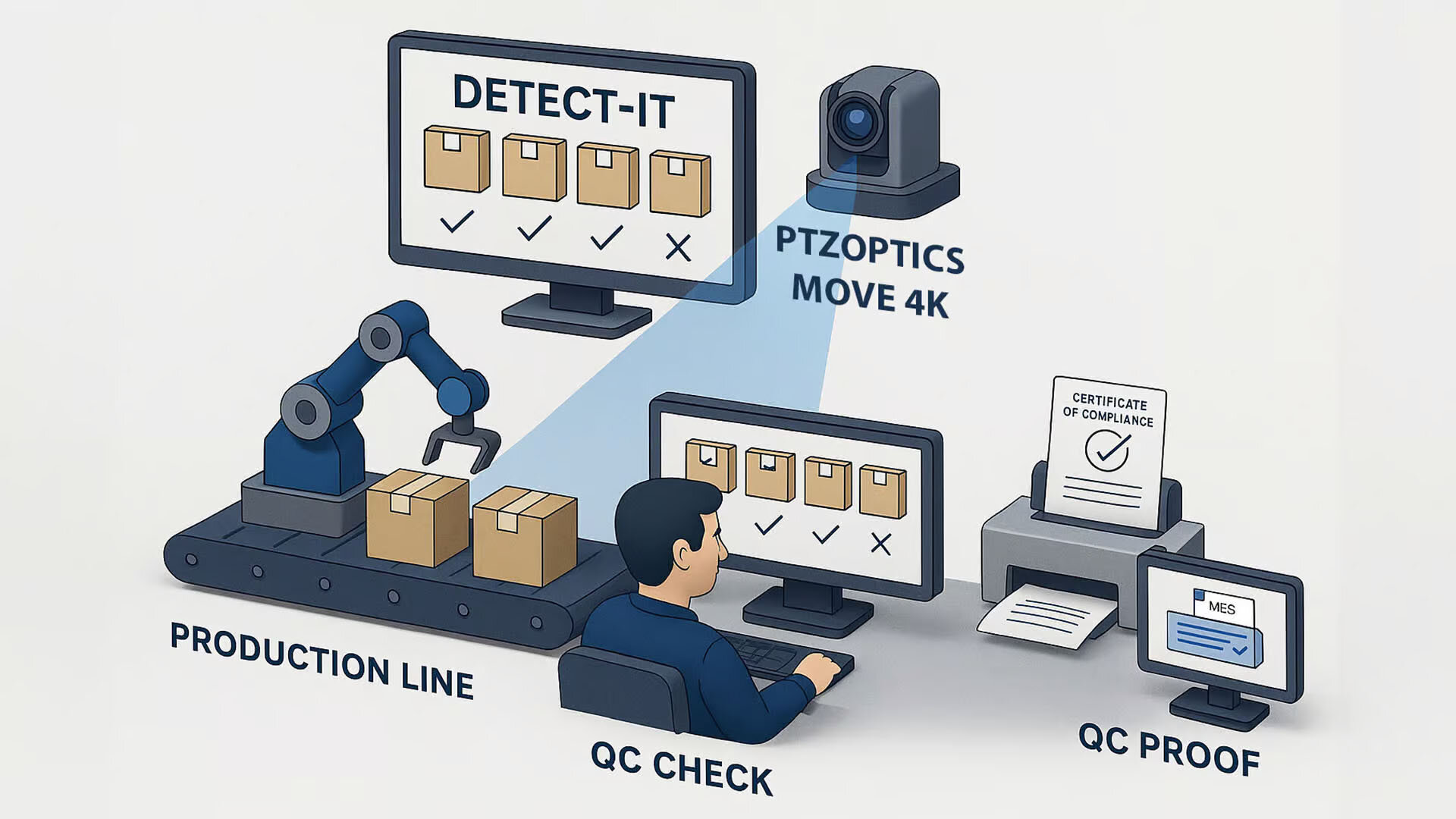
In industrial quality control, identifying a defect too late results in additional costs, waste, and production delays. The combination of PTZOptics cameras and Detect-It AI software enables real-time issue detection directly on the production line. Leveraging optical zoom and preset recall capabilities, the cameras can focus on critical points of components and capture detailed images, which the AI analyzes to identify anomalies.
Detect-It enables the creation of custom detection models simply by labeling a set of video examples—no programming is required, and everything runs locally, ensuring the security and confidentiality of industrial data. Once trained, the system can identify defects and inconsistencies, trigger alerts or external systems, and document each inspection with images and video clips.
The benefits scale further when multiple cameras are deployed: PTZOptics can monitor different areas of a production line—or multiple lines simultaneously—even remotely via PTZOptics Hive. This allows supervisory teams to oversee complex facilities from a single interface, improving consistency, operational efficiency, and overall product quality.
For companies looking to get started quickly, PTZOptics offers tailored proof-of-concept trials: simply provide a real production-line video, and the team will deliver a demo showing how AI would detect defects in that specific scenario. It’s a straightforward and effective way to understand how AI can modernize quality control and reduce errors before they become costly.
Toward a new generation of intelligent workflows
The Visual Reasoning initiative represents a significant evolution in how PTZ cameras can be integrated into professional AV systems, introducing a new operational model based on scene understanding and intelligent automation. The concept is simple yet transformative: turning video into a stream of interpretable data, ready to trigger automation, simplify complex operations, and reduce reliance on manual control.
Visual Reasoning adds a new layer of “intelligence” on top of the PTZOptics API: the API defines how the camera moves, while AI determines when and why.
In an industry where teams are often lean and productions increasingly dynamic, this capability represents a clear and tangible competitive advantage.
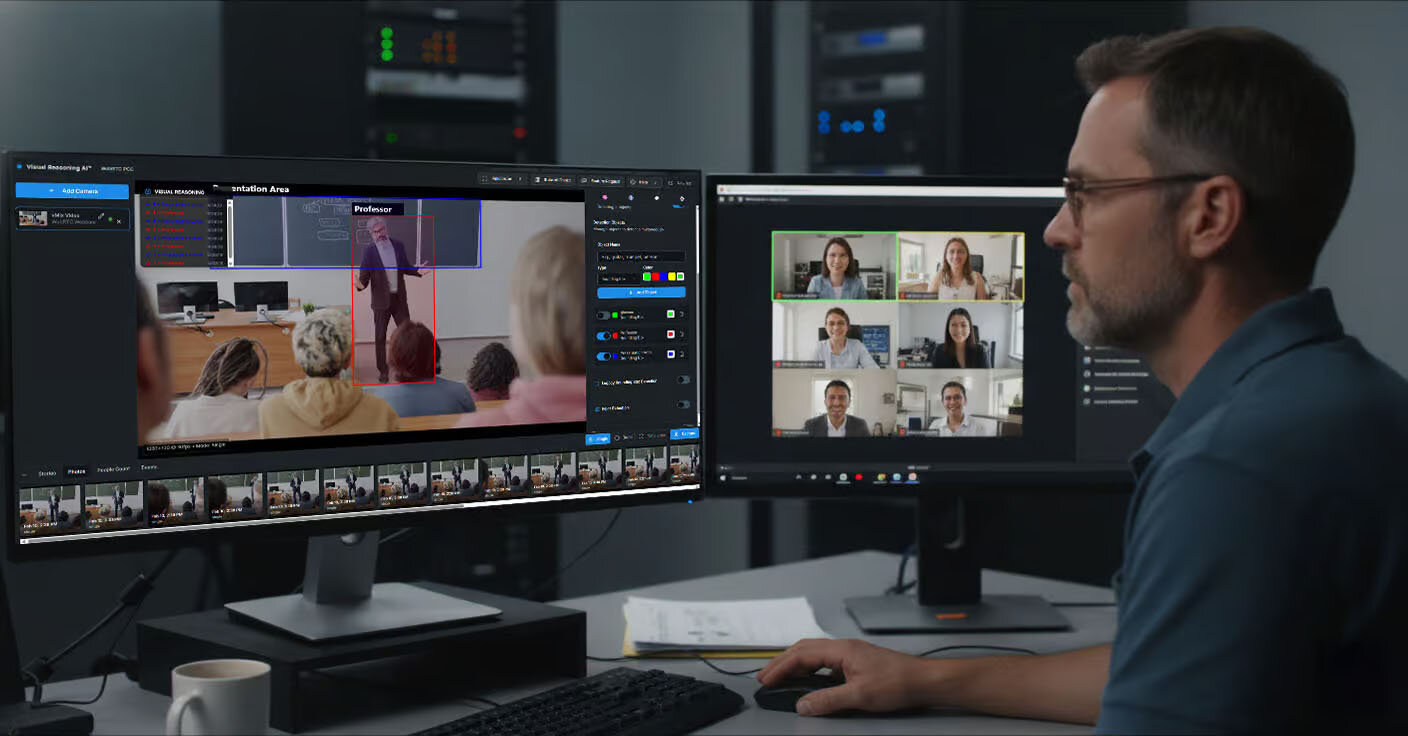
The fact that the entire ecosystem is open source paves the way for rapid adoption and continuous experimentation. System integrators, developers, and organizations can build tailored solutions, adapt AI models to their specific use cases, and actively contribute to the platform’s evolution.
This creates new opportunities across houses of worship, conference rooms, lecture halls, and unattended events: wherever a PTZOptics camera is installed, tasks that once required a dedicated operator can now be automated. The involvement of already active industry partners demonstrates that Visual Reasoning is not an abstract concept, but a technology ready for deployment in real-world, high-value environments.
For PTZOptics, this initiative represents a natural extension of its vision: accessible, flexible cameras designed to integrate into complex ecosystems. AI does not replace the operator—it enhances their capabilities, enabling a single technician to manage more sophisticated productions. From sports and education to healthcare and industrial manufacturing, new possibilities are emerging for professionals working with video.
Conclusion
Want to learn more?
Email us at international@audioeffetti.com


