
 English
  French

Ceiling speakers are among the most widely used loudspeaker types for permanent installations. Their key strength lies in their ability to integrate discreetly into indoor spaces, delivering even sound coverage without compromising aesthetics or design. Faced with an extremely broad market offering, brands such as Harmonic Design, Rondson, Lone Audio and Audiophony PA provide diversified product ranges designed to meet the needs of commercial environments, hotels and hospitality venues, schools, shopping centres, and voice evacuation systems.
Within the professional audio installation landscape, ceiling loudspeakers ceiling speakers, as they are commonly called have always played a central role. The possibility of concealing them within suspended ceilings and distributing sound evenly, with wide dispersion and top-down coverage, makes them essential in many applications.
Unlike other types of loudspeakers, ceiling speakers combine aesthetics and functionality, meeting the expectations of architects and installers who look for elegant, minimally invasive solutions, as well as those of technicians who are rightly focused on their acoustic performance. The brands represented by Audio Effetti interpret this category through different approaches, offering products ranging from 100 V distributed-line systems to models designed with Hi-Fi-inspired performance in mind.

The starting point: 100 V line systems
Before choosing which loudspeaker is best suited to our needs, we must first decide whether the installation will be a constant-voltage system (i.e., a 100 V line) or a low-impedance system.
As explained in an article of ours dedicated to this topic, 100 V line technology allows multiple loudspeakers to be connected in parallel along a common line, with each unit fitted with a transformer to adjust the power consumption. The main advantage is the ability to cover large areas with simple wiring and minimal losses, even over long distances. Sound quality, while not strictly Hi-Fi, is suitable for voice reproduction and background music, while the scalability of the system makes it easy to add or remove loudspeakers.
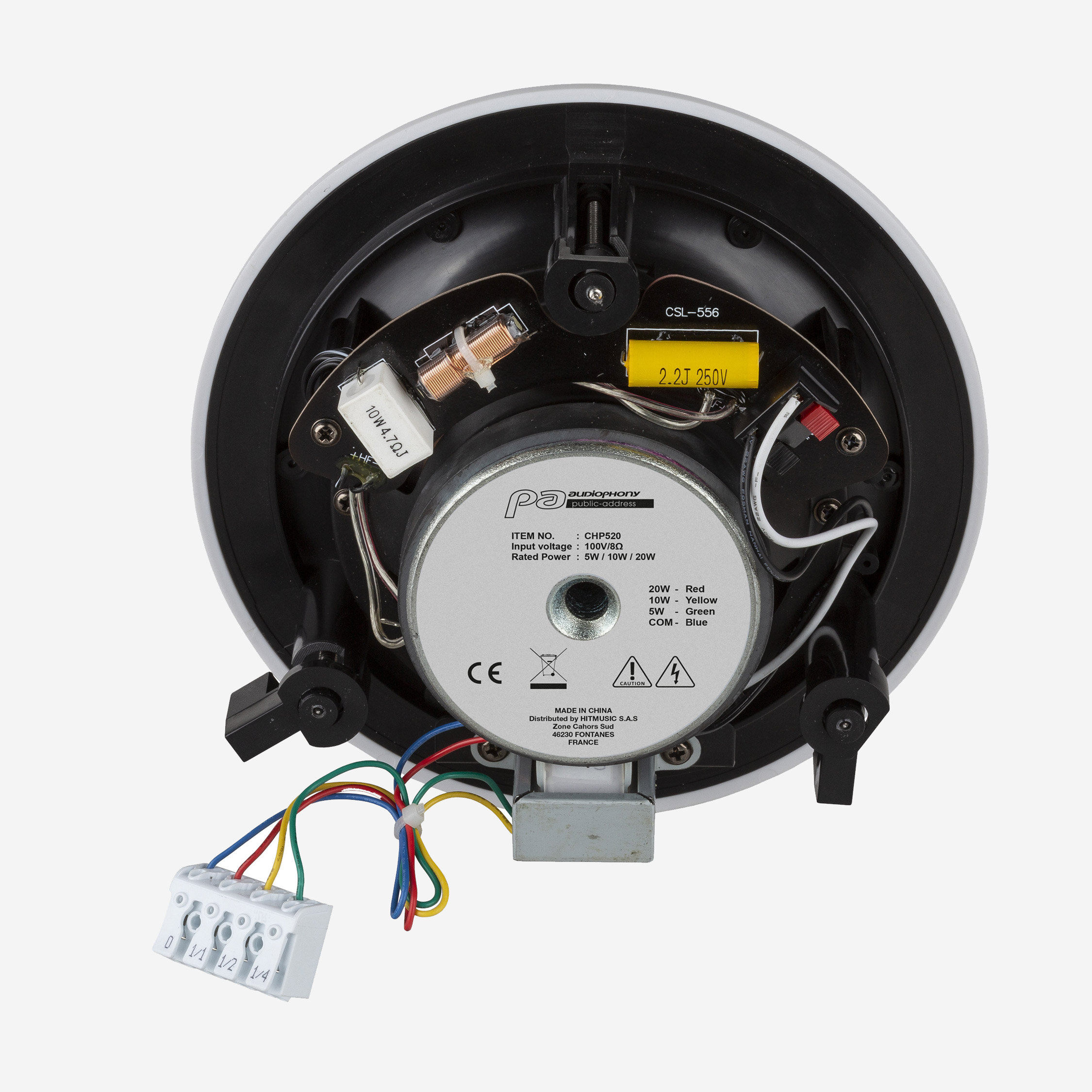
100 V ceiling speakers differ from traditional (i.e., low-impedance) models typically 4, 8 or (more rarely) 16 ohms only in the electrical section, due to the presence of the transformer and a terminal block (or selector switch) that allows the power rating to be selected. The magnetic assembly, voice coil, diaphragm, etc. are of course identical to those of conventional loudspeakers.
Calculating the total number of loudspeakers that can be used on a constant-voltage line is very simple, much to installers’ delight: you simply divide the amplifier power by the (adjustable) power rating assigned to each loudspeaker. For example, with a 100 W amplifier you can connect five 20 W loudspeakers (100 / 20 = 5). If the loudspeakers are rated at 10 W, you can connect ten of them. The calculation is very straightforward, because all you have to do is add up the individual power ratings until you reach the total.
But there is more: the 100 V loudspeaker chain can be made up of models with different power ratings. For instance, referring to the example above: two 40 W units (for a total of 80 W) + one 20 W unit, or three 20 W units + four 10 W units. The important thing is that the total power is equal to, or lower than, the amplifier output rating.
It is a different story with traditional loudspeakers, where you must take into account the simple rule that two 8-ohm loudspeakers in parallel result in a total impedance of 4 ohms, or that two 16-ohm loudspeakers in parallel result in a total impedance of 8 ohms. Therefore, you must avoid dropping below the minimum load impedance the amplifier is designed for, otherwise the protection circuitry will activate. In other words, a stereo amplifier capable of delivering 2 x 100 W into 8 ohms can drive only two 8-ohm loudspeakers, or four 16-ohm loudspeakers (two per channel).

From these considerations alone, it is clear why most installers prefer to work with constant-voltage systems at least when many loudspeakers are required, when zones with different power levels must be created, and above all, when costs need to be kept under control.
The speaker enclosure volume
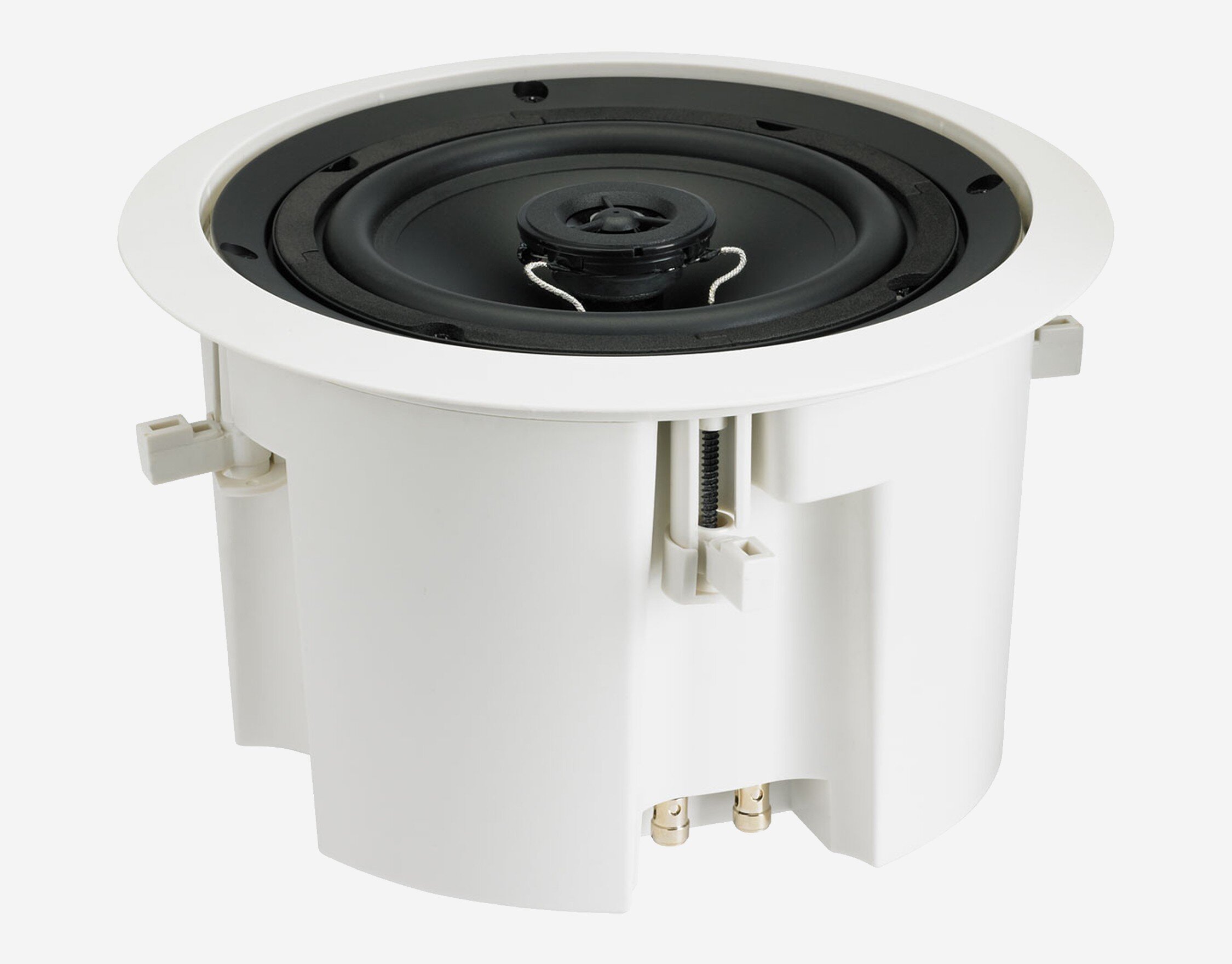
The enclosure volume is a key factor when discussing ceiling loudspeakers. Unlike Hi-Fi speakers, which are designed with carefully calculated cabinets to “tune” the woofer response and reduce resonances, an in-ceiling loudspeaker often operates in an undefined environment such as a suspended ceiling void or a wall cavity. This space, obviously not designed according to the transducer parameters, can affect audio performance, causing poorly controlled low frequencies, unwanted resonances, and irregular acoustic dispersion resulting in a “light” sound lacking body, which in professional installations can compromise speech intelligibility and make listening decidedly unsatisfying. In addition, an unmanaged volume can transmit vibrations to the structure, reducing acoustic comfort. To address these issues, many ceiling loudspeakers feature their own dedicated enclosure volume: small integrated cabinets, generally made of ABS, which isolate the diaphragm and ensure more predictable performance.
As an alternative, optional back-cans can be used accessories that create a sealed and controlled volume, widely adopted in installation projects. Choosing these solutions makes it possible to achieve more consistent and stable sound, turning an improvised system into one designed according to more reliable acoustic criteria.
Installation challenges
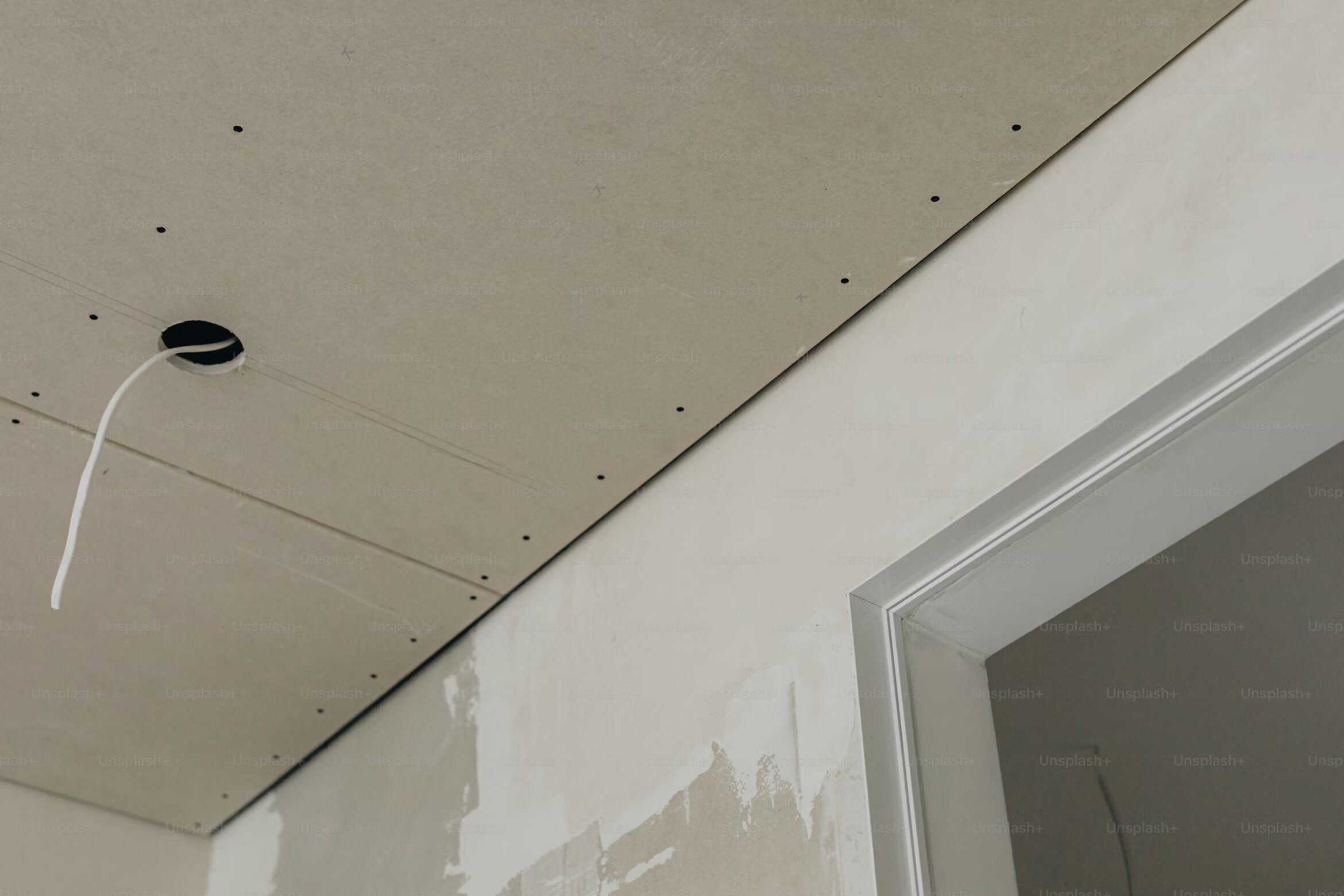
Ceiling loudspeakers stand out for a number of technical and functional characteristics. As mentioned, from an acoustic standpoint they are designed to distribute sound widely and evenly, reducing dead spots and ensuring speech intelligibility. They are installed flush-mounted into suspended ceilings, with slim front grilles magnetic and, if required, paintable so they can match the interior design. The installer will pay close attention to the loudspeaker dimensions, diameter and depth in particular, especially if there is already a cut-out in place where the unit must fit. Otherwise, the ceiling cut-out must be made accurately to prevent vibrations and ensure stability. For this reason, in most cases the manufacturer supplies a mounting template.
Speaker placement must be planned according to the geometry of the space in order to achieve uniform coverage. In public buildings, regulatory compliance is essential: in EVAC systems, for example, certified models must be used. Maintenance must also be taken into proper account: removable grilles and tidy wiring make future interventions easier and reduce system downtime.
Among installers, there is often a tendency to choose the smallest loudspeaker possible for example, when aiming to use existing spotlight cut-outs but of course a model with a larger diaphragm will be able to provide an extended frequency response and therefore a fuller sound in the low-mid range.

Features, types and models
Let’s now take a look at a selection of products from the Audio Effetti catalogue, both 100 V and low-impedance.
Rondson and Audiophony PA focus on robust and reliable solutions, often featuring an integrated transformer for use on 100 V lines. Lone Audio prioritises aesthetics and compactness, with discreet loudspeakers that are easy to integrate into hospitality and retail environments.
The Rondson CSL 100 V range includes many models with different price points and specifications, among which we would like to highlight the following:
- CLF-26T: a high-quality two-way in-ceiling loudspeaker, featuring a dome tweeter that can be slightly angled towards the listening area. It includes a sort of rear enclosure volume, which also protects the magnetic assembly and the diaphragm.
- CSL-640: a 12 cm diaphragm for this two-way model featuring a coaxial dome tweeter, a flat magnetic metal grille and an ABS frame. Easy to install, it offers very good performance and is suitable for installations in shops, restaurants and public venues. Also available in black.
- CSL-443K: this quick-mount 80 mm loudspeaker, for ceilings with a thickness of 2–20 mm, is fitted with a rear cover that acts as an enclosure volume and also ensures water resistance, as it is IP64-rated. Ideal for use in environments with high humidity or direct exposure to water, such as swimming pools.
Audiophony PA offers, among the 15 models available…
- CHP660, a 6.5” coaxial ceiling loudspeaker that can operate either in 70 / 100 V mode or at 8 ohms, depending on the selected configuration.
- CHP630SQ, a two-way model, notable at least for the distinctive feature of its square grille. It includes a 5" woofer plus a 1/2" coaxial tweeter.
When it comes to the most representative low-impedance models, we would like to highlight:
- Lone Audio LA-CS80, a high-quality two-way coaxial driver, sold as a pair, suitable for both ceiling and wall installation. It operates at 8 ohms. It can cover an area ranging from 65 to 100 m² when installed at a height of 4 or 5 m.
- Lone Audio LA-120WIKIT, a versatile kit consisting of one active loudspeaker, with integrated Bluetooth and Wi-Fi receivers, and one passive in-ceiling loudspeaker. The two units are connected to each other via a supplied 5 m cable, forming a stereo pair. By pairing it with a mobile device equipped with a wireless interface, music can be played directly without the need for any additional units. A remote control is included.
- Audiophony PA CHF860: a 2-way Hi-Fi in-ceiling loudspeaker with an 8” woofer and a 1” dome tweeter, featuring its own dedicated enclosure volume and characterised by high sound quality. It supports up to 250 W maximum power. 8-ohm impedance.
- Rondson CSL-08-IP: a unique transducer within the range of products distributed by Audio Effetti. Suitable for all types of suspended ceilings and equipped with a quick-fixing system, it is powered via PoE (or 24 V DC), includes an 8 W amplification stage as it is an active loudspeaker, and is controlled via TCP/IP, UDP or IGMP interface. It does not feature a Dante Audio input, therefore it is necessary to use a remote management and control system via AM IP SOFTWARE.
Finally, Harmonic Design offers a low-impedance ceiling speaker with Hi-Fi performance, ideal for environments where sound quality is a priority. It is called IC230 and is a 2-way coaxial loudspeaker with a bass-reflex loaded woofer. It operates both at 8 ohms and at 70 / 100 V and provides conical dispersion with an 80° coverage angle. Installation is quick and easy thanks to the quick-release mounting clips and the included cut-out template, while the paintable front grille allows perfect integration into any environment. It is suitable for spaces with structural constraints thanks to its reduced installation depth of just 99 mm.
The price issue
Experience shows that, unfortunately, ceiling loudspeakers for fixed installations are often underestimated. As a result, venue owners tend to rely on a standard electrician for both selection and installation, effectively treating this component as if it were a light bulb, a fuse, or a lighting control unit. This mistaken approach most often leads to a race to cut costs, based on the belief that a shop, retail space, restaurant or showroom can be properly covered with sound using four ceiling speakers while spending as little as possible. If this route is taken, the outcome will inevitably be proportional to the price meaning disappointing.
Conclusion
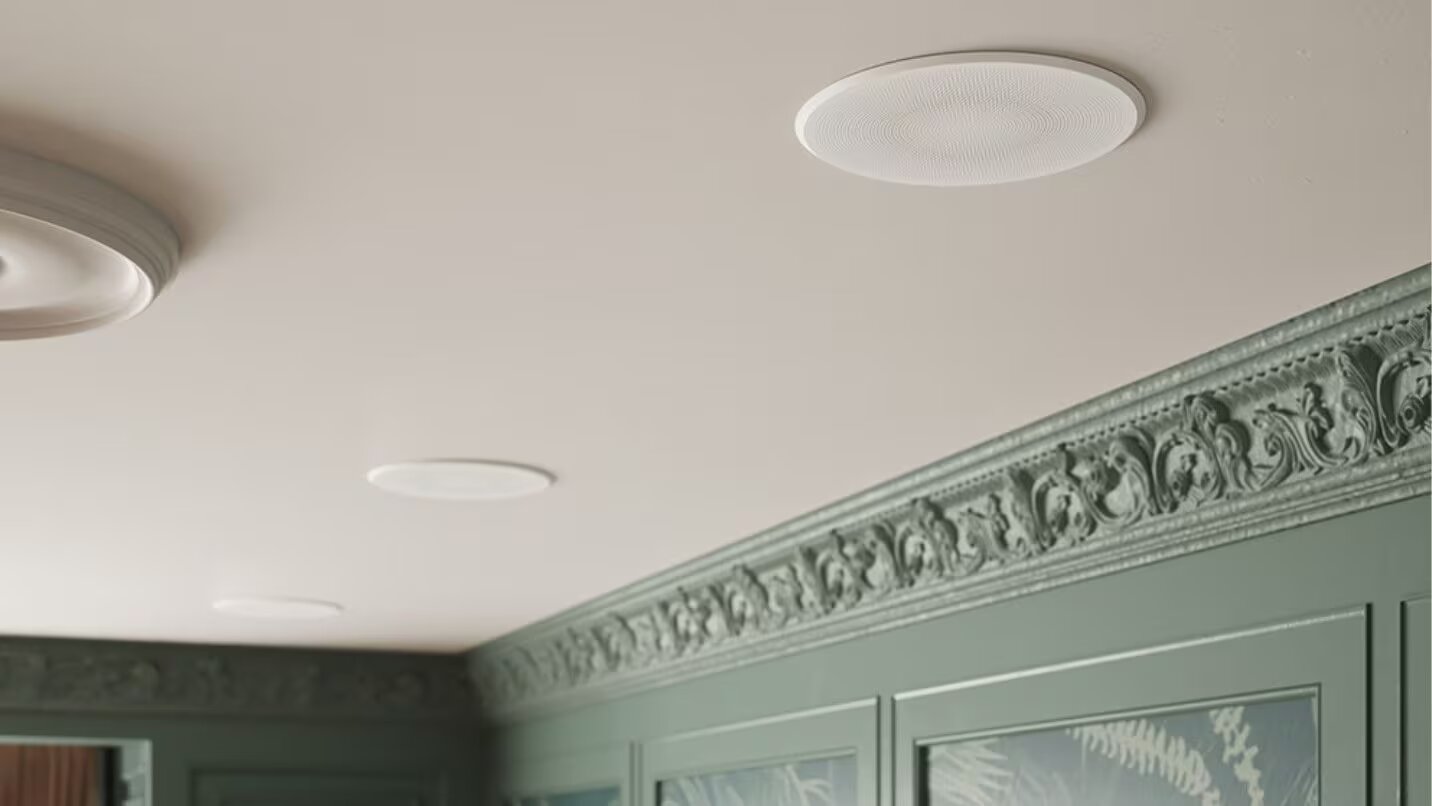
Ceiling speakers, thanks to their discreet appearance combined with the ability to provide uniform sound coverage, play a key role in both public and private environments. Rondson, Audiophony PA, Lone Audio and Harmonic Design offer a wide range of options to meet every need from speech to background music, all the way to regulatory compliance for safety systems.
Want to learn more?
Email us at international@audioeffetti.it


