
 English
  French

Intercoms are essential devices for ensuring clear, immediate, and reliable communication among team members in live productions, music events, corporate, sports, theater, trade fairs, and broadcasting. In this article, we will analyze their features, how modern digital wireless systems work, and why they are becoming a standard, at least in our sector. We will then conclude with an in-depth look at CoMo II, the new full-duplex DECT 1.9 GHz system, the MKII version of the already well-known Accsoon Intercom.
In the world of live productions, corporate events, broadcast, and large film or theater productions, communication among crew members is a delicate, if not critical, element. Direction, camera operators, audio technicians, stage operators, and stage managers must be able to coordinate in real time, without delays, interference, or misunderstandings. This is where Intercoms come into play, dedicated communication systems that allow multiple operators to talk to each other and listen simultaneously in a clear and reliable way.
Although the term "Intercom" is very broad and also includes systems for military, industrial, or security use, in the entertainment and media sector it refers to devices designed to ensure two-way communication in complex, noisy, and dynamic environments.
The ABCs of Intercoms
Intercoms are full-duplex communication systems designed to allow multiple users to speak simultaneously, without having to press buttons or activate specific channels.
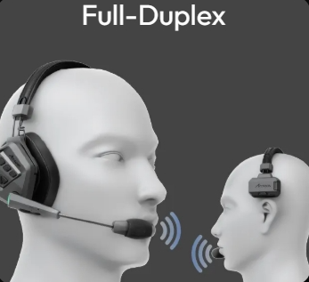
Unlike walkie talkies, which operate in half-duplex and allow only one person at a time to speak using push-to-talk mode, Intercoms allow continuous, overlapping conversations, just like a phone call. To be honest, the concept of Intercom comes directly from telephony, which is why it originally developed around a type of 2-wire cabling, even though - it should be emphasized - telephone and Intercom do share the same basic function, but they implement it in a completely different way: the telephone is used to communicate, the Intercom to coordinate.
In modern professional productions, Intercoms therefore represent the basis of operational coordination: they allow the control room to communicate with operators, audio, lighting, and video technicians to synchronize with one another, and stage teams to manage scene changes, movements, and timing with precision. They are also used for backstage access control, for security, for managing corporate events and conferences, as well as in television productions and streaming, where communication must be constant and free of uncertainty.
A first classification distinguishes Intercoms between channel-based and point-to-point systems. A channel-based Intercom organizes users into closed groups that communicate simultaneously, preventing interaction between separate channels. By contrast, a point-to-point Intercom allows flexible and direct communication between individual stations, and is therefore ideal for complex productions that require dedicated configurations.
A second classification concerns the signal transmission medium: wired or wireless. In recent years, alongside traditional wired systems, which offer absolute connection stability and are often used in theaters and television studios where the infrastructure is already in place (see Datavideo ITC-100, for example), wireless Intercoms have seen growing adoption thanks to their flexibility, improved audio quality, and the ability to work without the constraint of cables.
They therefore allow operators to move freely and can be put into operation quickly, making them ideal for traveling events, dynamic sets, and productions that frequently change configuration. In most cases, the two technologies coexist within the same production, integrating into a single communication network that combines safety, stability, and operational freedom.
Within this last category, namely wireless Intercoms, there are digital models, that is, models that use radio transmission protocols of this type, such as DECT, 2.4 GHz, or encrypted proprietary solutions to ensure more stable communication, better audio quality, and greater immunity to interference compared with traditional analog systems.
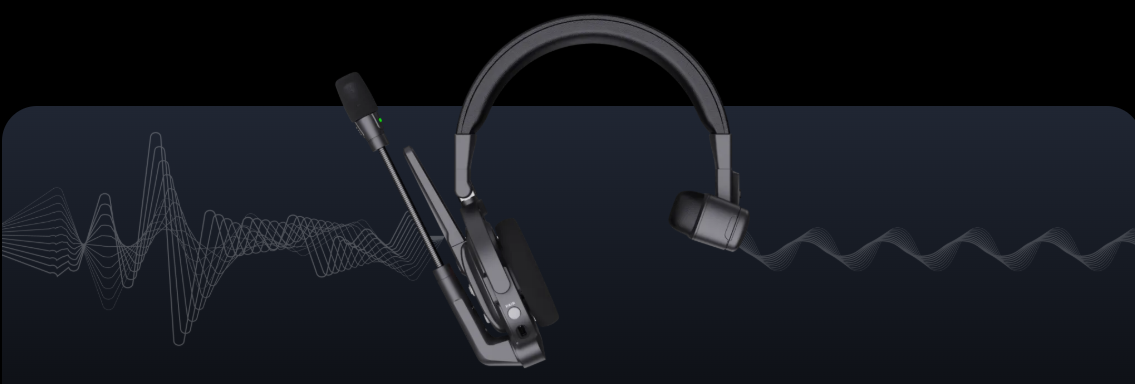
Digital transmission also makes it possible to provide advanced functions such as multi-group management, signal encryption, noise reduction through DSP algorithms, and extremely low latency, features that make it particularly suitable for modern productions, where dialogue clarity and connection reliability are essential elements.
Wireless Intercoms in Modern Productions
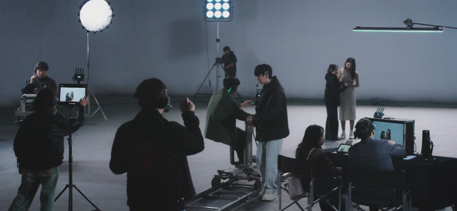
In recent years, wireless Intercoms have taken on an increasingly central role in modern productions, not so much as an alternative to wired systems, but as a natural extension of contemporary operational needs. Live, television, and corporate productions today require continuous mobility: operators moving between stage and backstage, crews working on dynamic sets, technicians who must intervene quickly in distant areas or areas unreachable by fixed cabling. In this context, wireless communication is no longer an optional extra, but a necessity.
The technological maturity reached by current wireless systems - based on digital transmissions such as DECT 1.9 GHz or low-latency proprietary protocols - has made it possible to achieve a level of reliability that until a few years ago was the exclusive prerogative of wired systems. Today wireless Intercoms use stable, dedicated radio links capable of ensuring clear audio, minimal latency, and high resistance to interference even in congested RF environments, where Wi-Fi networks, control systems, video transmissions, and numerous radio devices coexist. Audio quality is now comparable to that of wired systems, thanks to cardioid-directional microphones that reduce the contribution of ambient noise and DSP algorithms that keep the voice intelligible even in very noisy contexts, as well as the reliability of the link.
Another factor that has favored the adoption of wireless Intercoms is how quickly they can be deployed. In many contexts it is not possible, or not practical, to lay cables, prepare patches, or integrate fixed systems: think of traveling festivals, corporate events that change location every day, temporary TV sets, or productions that require different configurations for each performance. A wireless system can be activated in a few minutes, without special intervention and without the need for specialized staff for the cabling side.
Scalability is another strong point. Modern systems make it possible to quickly add new users, create separate groups for control room, stage, camera crew, or security, and manage parallel communications without interference. This modular approach makes it possible to adapt the system to the production's needs, which can grow or shrink depending on the type of event.
Despite their "wireless" nature, wireless Intercoms integrate advanced security and control functions: communication encryption, protected pairing, priority management, and automatic muting systems ensure reliable use even in critical contexts. For this reason, today they are used not only in concerts and live events, but also in broadcasting, theaters, trade shows, conferences, video productions, and corporate settings.
Ultimately, wireless Intercoms are the most modern response to the operational needs of contemporary productions: they combine freedom of movement, high audio quality, fast implementation, and a flexibility that makes them indispensable in any dynamic scenario. It is precisely in this context that Accsoon CoMo II fits in, one of the most innovative systems of the new generation.
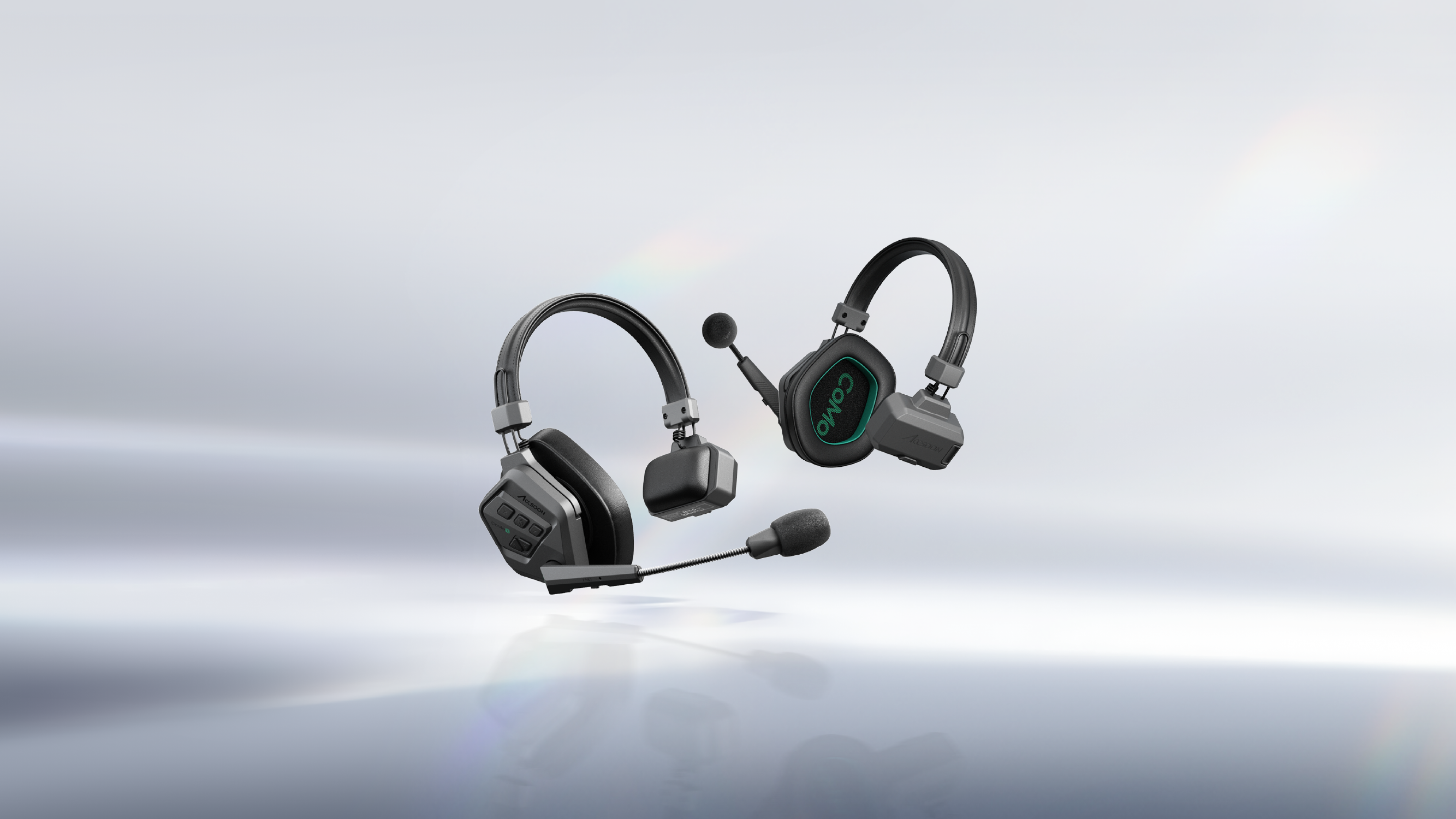
Accsoon CoMo II
Accsoon CoMo II represents a new generation of wireless Intercoms designed for modern productions: lightweight, quick to use, beltpack-free, and based on DECT 1.9 GHz technology, a choice that ensures stability, low latency, and extremely clean audio even in environments crowded with radio interference. The product philosophy is to offer a professional system that retains the user-friendliness typical of consumer devices, but with the performance and reliability of a true production tool.
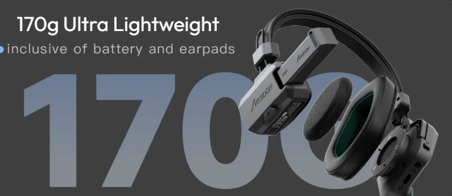
One of the most distinctive elements of CoMo II is its headset-based architecture: each unit is at the same time headphones, microphone, and communication terminal. There are no beltpacks, cables, or other external devices; you just turn on the host and the remote units connect automatically. This approach drastically reduces setup times and makes the system ideal for traveling events, corporate productions, video sets, and situations where operational speed is essential. The extremely low weight - less than 170 grams, including earcups and battery - contributes to real comfort even after many hours of use, an aspect greatly appreciated by operators and technicians who must wear the Intercom for entire working days.
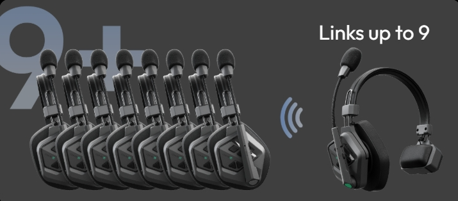
The system supports up to nine total users (1 host + 8 remote):
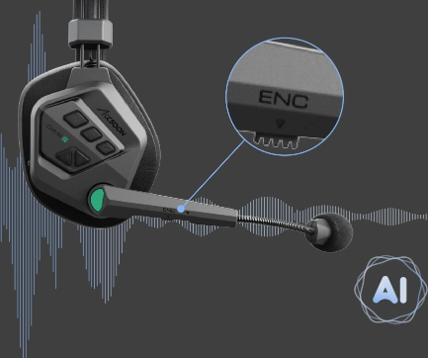
From an audio standpoint, CoMo II integrates one of the most advanced technologies in the industry: Dual Mic ENC + AI ENC dual noise reduction. The system combines a dual-microphone architecture with artificial intelligence algorithms in a two-stage processing pipeline. The first microphone captures the operator's voice, while the second detects ambient noise; the DSP compares the two signals and reduces noise in real time. To this intervention is added AI ENC, an algorithm trained to distinguish the human voice from the typical noises of operating environments (wind, traffic, audience, machinery). The AI analyzes the audio spectrum, recognizes vocal patterns, and selectively suppresses residual noise, progressively adapting to the environment and the operator's vocal characteristics. The result is clearer, more natural, and more stable communication even in very noisy contexts.
In addition to noise cancellation, CoMo II integrates zero-latency sidetone that returns the operator's own voice to the headset immediately, ensuring a natural perception of speech and preventing the echo effect typical of wireless systems. We will discuss this more extensively in a future dedicated article.
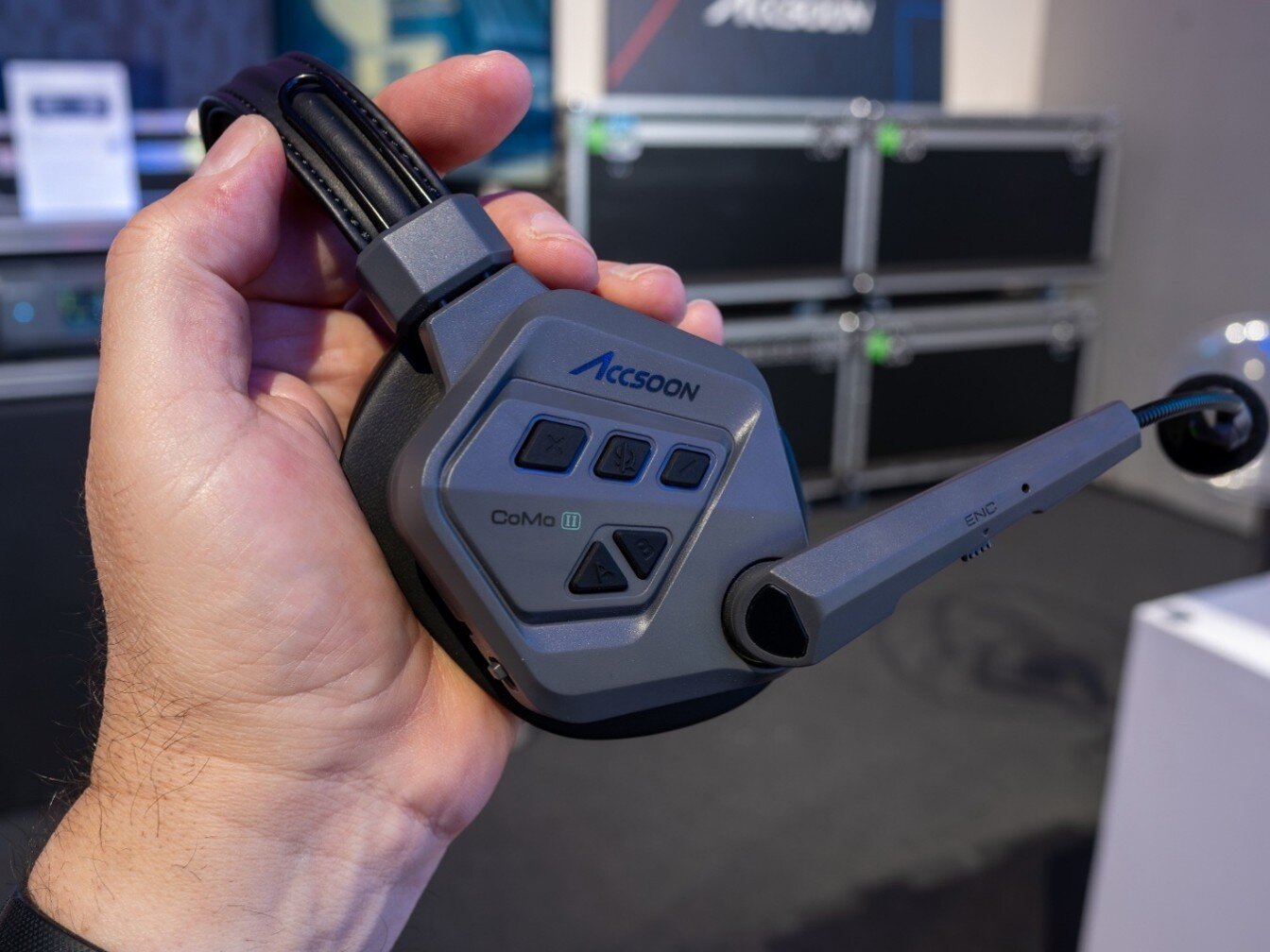
Another noteworthy feature of this product: through a 3.5 mm mini-jack connector, it allows the connection of headphones or external earphones chosen by the user, combining hygiene, comfort, and a personalized communication experience.
Another distinctive function, also present in the first CoMO version, is Flip-to-Mute: by lifting the microphone boom, audio is automatically muted. It is a natural, immediate, and very useful gesture in the control room or backstage, where operators often need to communicate with people outside the system without disturbing the group's conversation. The microphone is also designed to be used on either the right or left side, adapting to the operator's preferences.
Not only that: Accsoon CoMo II features an innovative structural design that adapts to different head shapes for a comfortable fit. Even in dynamic shooting environments, it remains firmly in place for clear communication with the team.

Battery life is another strong point: the host can reach 11 hours of operation, while the remote units last up to 17 hours, thanks to quick-release removable batteries that can be replaced in a few seconds. This makes CoMo II suitable even for long productions, day-long events, or sets that require continuous operation without interruption. Charging takes place via USB-C, and the system can also be powered while in use, an important advantage in critical situations.
The 400-meter line-of-sight range, finally, ensures sufficient coverage for most live events, television productions, and corporate installations. The stability of the DECT signal also makes it possible to work in complex environments without interference from Wi-Fi networks, Bluetooth, or RF systems used for audio and video.

Conclusions
Accsoon CoMo II is a wireless Intercom designed to offer audio quality, ease of operation, immediacy of use, and advanced functions. It is a solution aimed at technicians, directors, operators, and production teams looking for a reliable, modern, and easy-to-deploy system, without giving up features typical of high-end systems. The combination of lightness, battery life, intelligent noise cancellation, and beltpack-free architecture makes it one of the most interesting Intercoms in its category.
Want to know more?
For more information, contact your local agent or write an email to info@audioeffetti.it


