
 English
  French

EVAC systems are voice alarm systems designed to guide the people involved during an emergency toward the escape route through a series of clear, concise, and understandable messages for everyone. Today they are an essential fire safety measure and are governed by specific standards that define their requirements, performance, and areas of use. The Rondson EVA-3000M control unit and the related connected devices perform these tasks at their best, integrating announcements and multi-zone supervision into a single compact system.
Audio Effetti, as we know, was born and grew in the world of entertainment and technologies tied to the show business: professional audio and video, lighting, special effects. It has always been our core business, our identity. In recent years, however, the installation sector has become a major part of our work: complex projects, systems integration, solutions for corporate, hospitality and retail environments.
In this evolving scenario comes today’s topic, apparently far from our usual language but in fact perfectly aligned with the demands of today’s market: EVAC systems, voice alarm systems intended for emergency management and fire safety.
This is a topic not very common in our sector, often confined to the technical world of fire prevention, but one that deserves attention, also because our represented brand Rondson has in its catalog a particularly interesting EVAC platform based on the EVA-3000M control unit. To understand how it works, it is useful to briefly review what these systems are, why modern regulations consider them essential and which requirements they must meet to ensure speech intelligibility, operational continuity and reliability during an emergency. Only after this general overview will we go into detail on the Rondson EVA-3000, analyzing its functions, features and real applications.
An overview of voice alarm systems
The function of an EVAC system is easy to describe, but more complex than one might think to achieve: to broadcast vocal instructions that remain understandable even in critical conditions, when noise, confusion and psychological pressure can compromise the ability to react correctly, is in fact no trivial matter. The voice, compared with sirens, captures attention and reduces the risk of panic, promoting a faster and more controlled response.
Unlike traditional acoustic signals, which are limited to indicating the presence of a danger, an EVAC system communicates:
- What to do
- Where to go
- How to behave.
This approach is now considered essential by modern fire regulations, which require not only the presence of an alarm, but also the ability to manage evacuation in an orderly and safe manner.
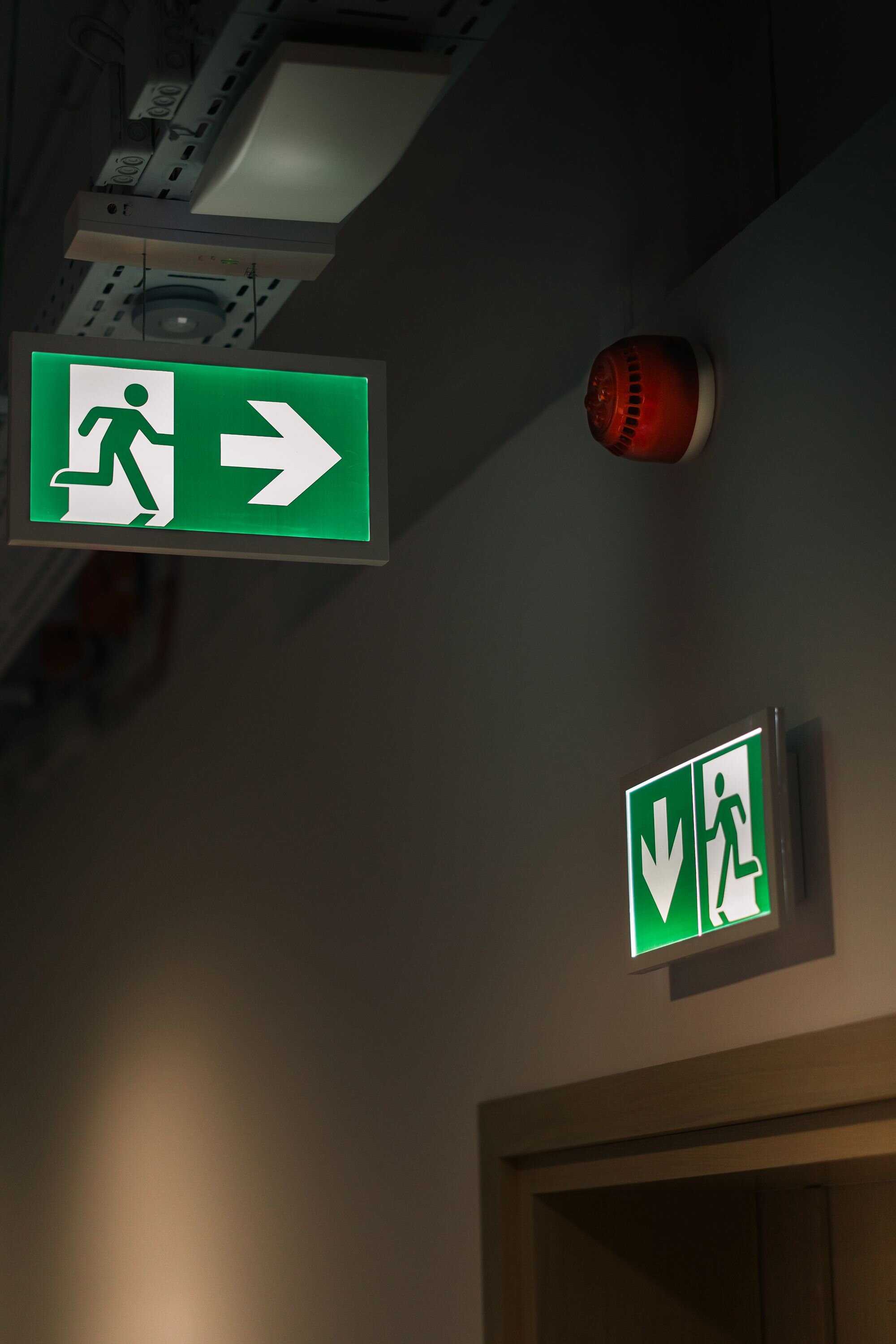
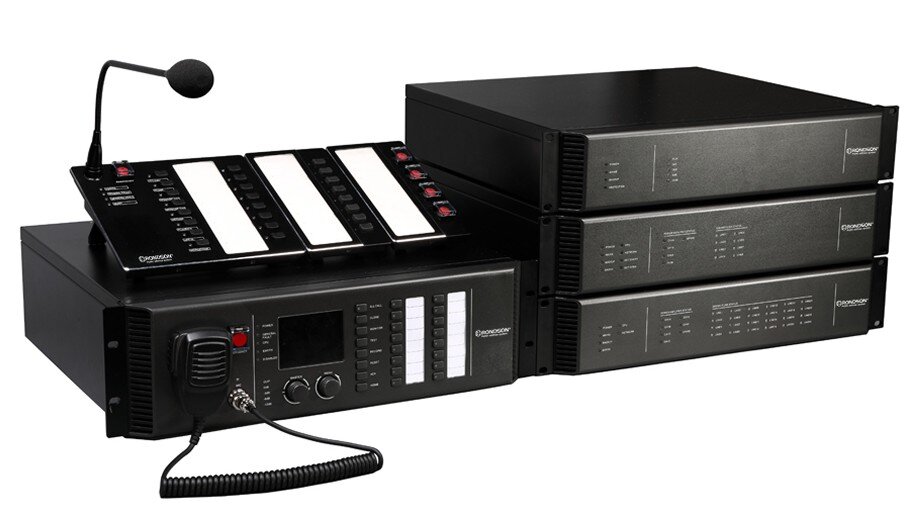
An EVAC system is generally made up of:
- A certified EN 54-16 control unit
- Dedicated multi-zone amplifiers
- EN 54-24 certified loudspeakers
- Microphone stations for live announcements
- A fire-resistant cabling infrastructure
All these elements must work in a coordinated way, ensuring operational continuity even in the event of faults, power outages or adverse environmental conditions. The system must also always be available and functioning, with backup power, regular maintenance and constant fault monitoring.
An EVAC system is not a simple audio system: it is an active protection measure that combines technology, regulations and design to ensure that, at the most critical moment, communication is clear, reliable and immediate. Messages must be audible and understandable in every area of the building, including stairwells, bathrooms and parking lots.
European standard EN 54-16 defines the requirements for control and indicating equipment for voice alarm systems. It is the certification that distinguishes a normal sound distribution system from a true EVAC system.
According to EN 54-16, the control unit must ensure:
- Automatic activation of emergency messages
- Continuous supervision of power supplies, amplifiers, loudspeaker lines, microphones
- Redundancy in the event of faults
- Absolute priority to evacuation messages
- Monitoring of loudspeaker lines even during broadcasting
- Integration with the fire detection system
- Operational continuity even in the event of malfunctions
In short, EN 54-16 establishes that an EVAC system must always be operational, supervised and ready to broadcast an emergency message. All safety equipment must comply with EN 54-16 and be installed according to the relevant regulatory frameworks.
Why EVAC systems have become indispensable
As we said, the spread of EVAC systems stems from a concrete need: traditional acoustic signals are no longer considered sufficient to ensure effective emergency management. A simple continuous or intermittent sound indicates the presence of a danger, but it does not communicate what is happening, where to go, which areas to avoid or how to behave. Modern fire regulations, based on Fire Safety Engineering studies, have shown that people react faster and more orderly when they receive intelligible voice messages, capable of reducing uncertainty and guiding evacuation with precise instructions.
This is why EVAC systems have become an essential safety measure:
- They make it possible to contextualize the emergency, indicating the nature of the danger
- They guide occupants with clear and understandable messages, even in noisy environments
- They allow selective evacuation, avoiding involvement of areas not affected by the risk
- They reduce reaction times
- They ensure operational continuity even in the event of faults, thanks to constant supervision
- They integrate with fire detection, activating automatically within a few seconds
- They indicate the nearest and safest exit routes, providing additional information according to the situation
- They help avoid panic and rushing, reducing the risk of secondary incidents
- They can operate in parallel with the fire system to avoid dependencies that could cause simultaneous faults
In other words, an EVAC system is not only used to "get people out", but to get them out the right way, avoiding panic, overcrowding and instinctive behaviors that can worsen the situation.
It is this logic - more advanced, more human and more effective - that has led regulations to make EVAC systems mandatory in many high-occupancy or complex facilities, and that today guides the design of certified EN 54-16 PA/VA systems.
Rondson EVA-3000: how it is built and how a modern PA/VA system really works
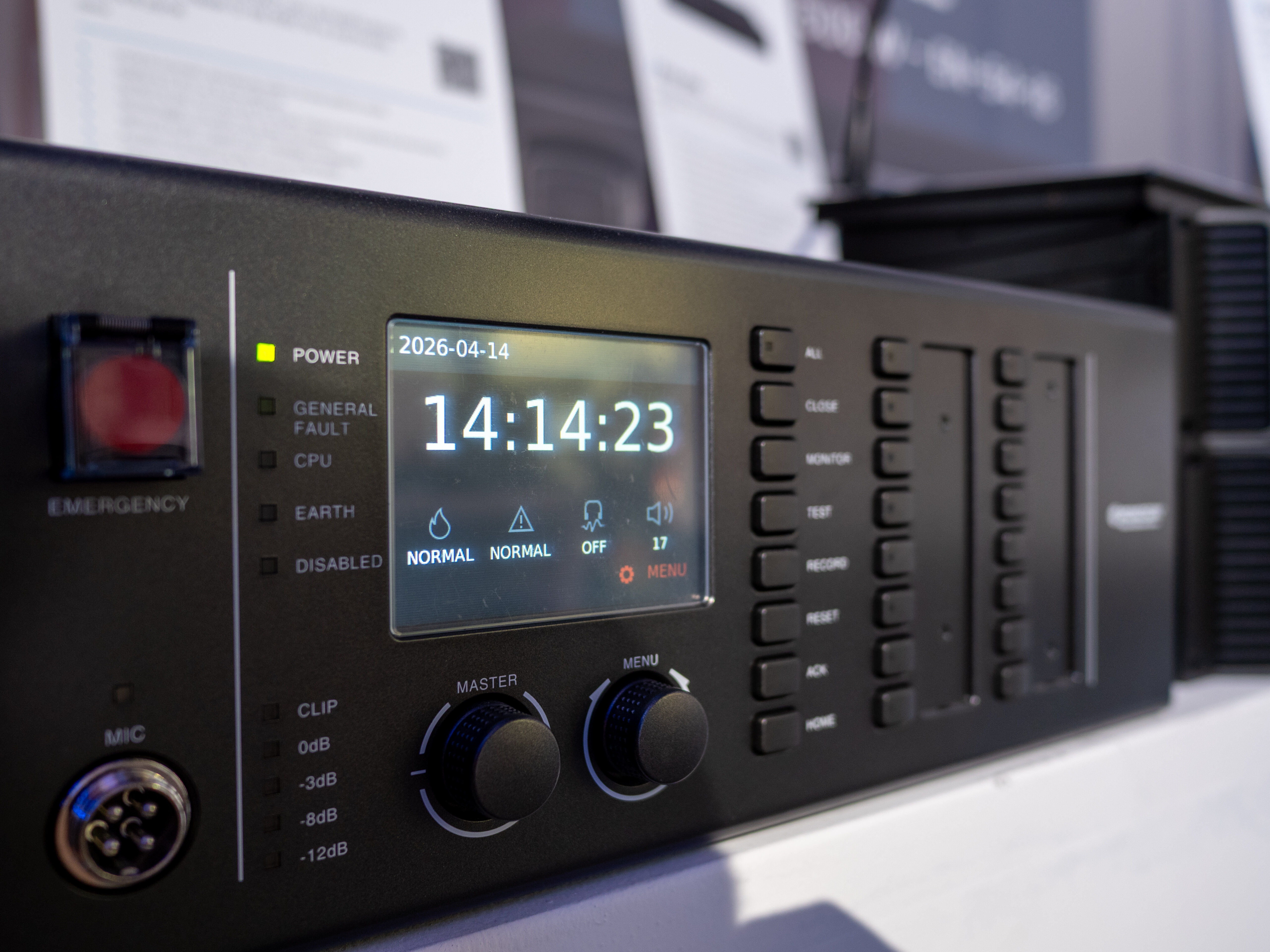
EVA-3000M is the control unit that governs the entire Rondson sound reinforcement and voice alarm system, the latest one presented by the company. Unlike traditional distribution systems, here we are not talking about a simple multi-zone amplifier with a few control functions, but about an EN 54-16 certified device.
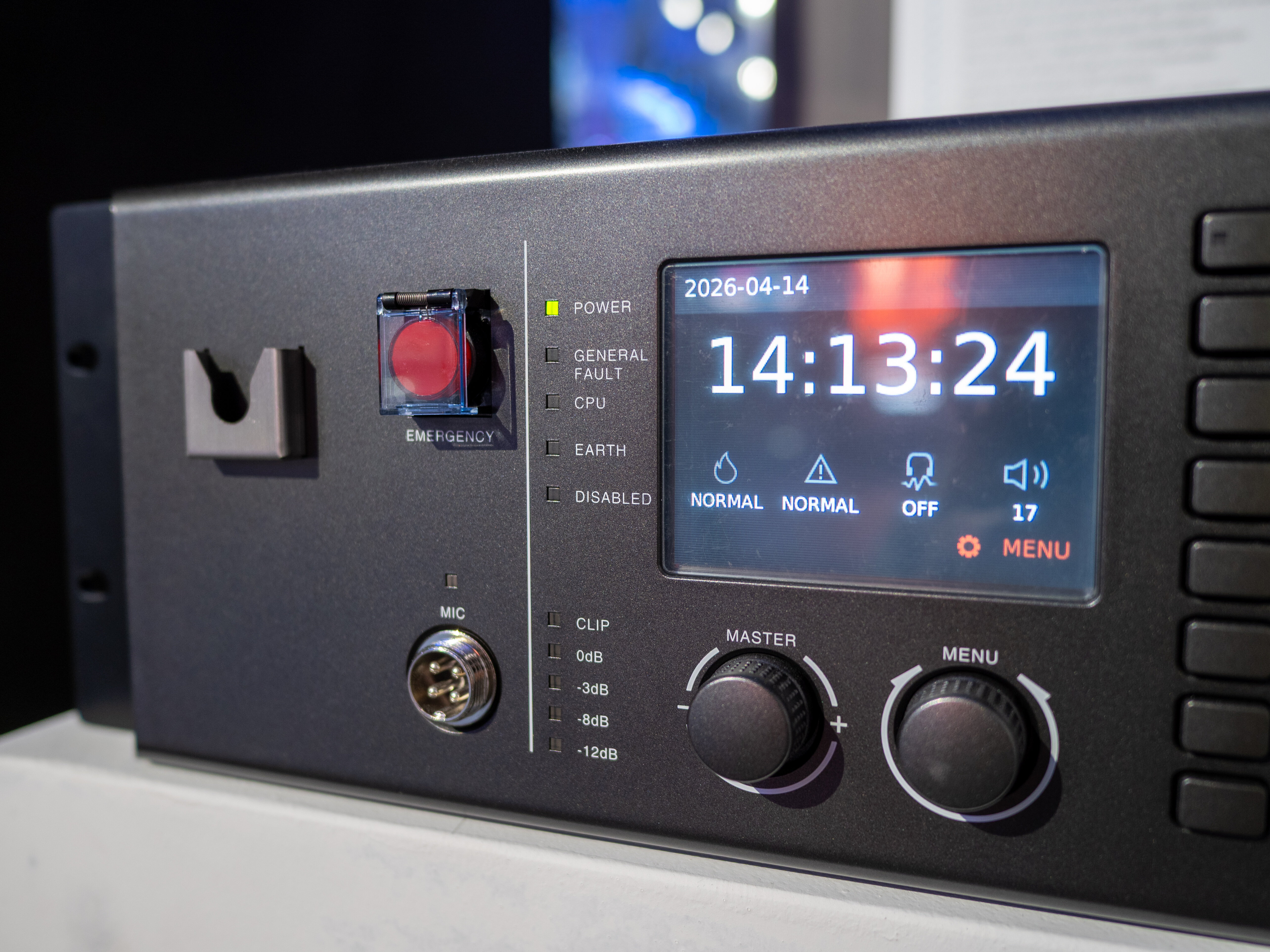
The heart of the central unit is a Cortex-A8 processor, chosen not for its raw computing power, but for its ability to integrate functions that would normally require several separate modules. EVA-3000M manages supervision logic, fault diagnostics, priority handling, message recording and zone control. Everything is monitored: power supplies, CPU, internal and external amplifiers, A/B lines, dry contacts, network, PTT microphone. The system always knows if something is not working and can react immediately, logging the event and guiding the operator through diagnosis via the 3.5" TFT display.
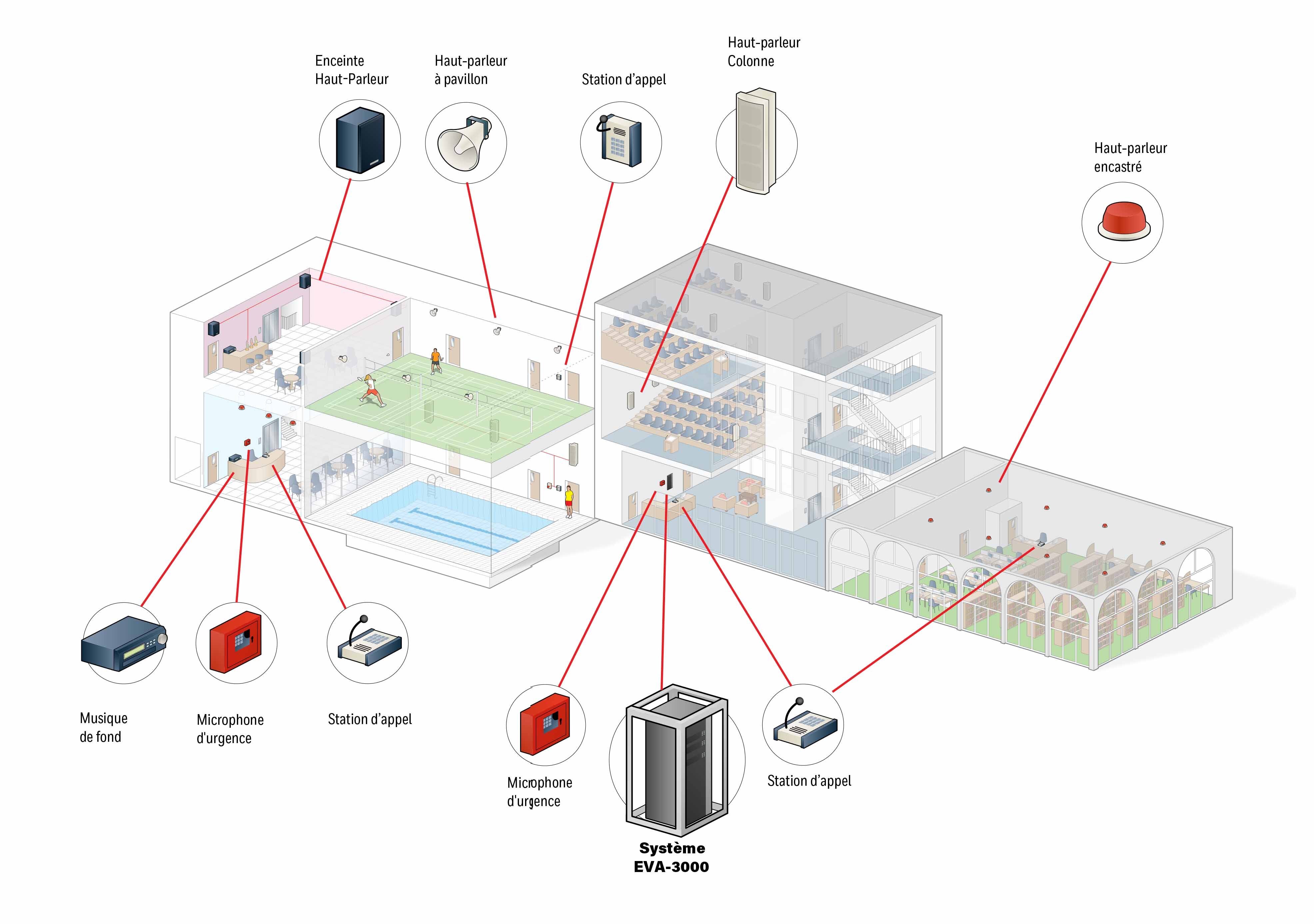
One of the most important aspects is amplifier management. EVA-3000M integrates a 500 W Class-D amplifier that can drive up to eight speaker lines, each with independent A/B output. The dual line per zone is not a detail: it allows continuous supervision even during broadcasting, a fundamental requirement for EN 54-16 certification. The control unit can also automatically route the signal to a backup amplifier when it detects a fault. A spare amplifier is not needed for every zone: one backup amplifier for the whole system is enough, with huge cost savings and fewer points of failure. When more power or more zones are needed, EVA-3000M can be paired with the EVA-500 500 W amplifier dedicated solely to amplification, or with external amplifiers connected via CH1, CH2 and spare amplifier outputs.
The internal audio matrix can operate in single or dual channel mode. This allows background music, service messages and emergency announcements to be managed simultaneously, with configurable priorities up to 255 levels. The two CH1 and CH2 channels can be used to separate ordinary content from safety content. The system can also record temporary messages via the PTT microphone or the call station, storing them on the integrated 1 GB flash card and 4 GB SD card.
Zone management is another of the points that sets EVA-3000M apart from a traditional distribution system:
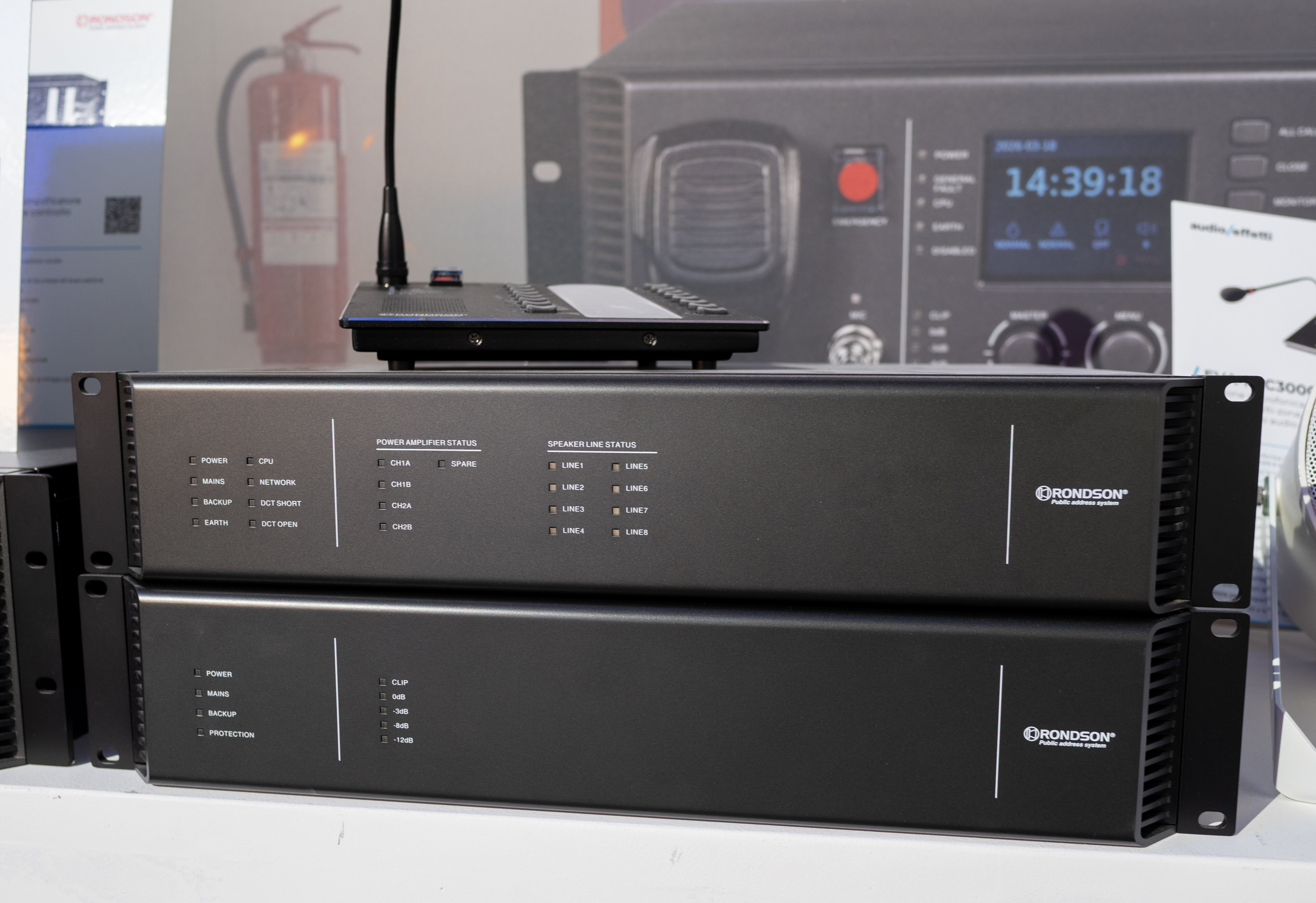
The zones are eight, but the control unit can be expanded through EVA-EXT3100 modules, each of which adds another eight zones with dual A/B line and full supervision. Each expander can host up to four external amplifiers plus one backup amplifier, has dry contact inputs and outputs and can operate in local or network mode. The system can be expanded to thousands of zones via IP network, allowing coverage of complex buildings or multi-structure campuses. Even during broadcasting, the A/B lines of the expanders are supervised, ensuring operational continuity even in the event of a central controller fault.
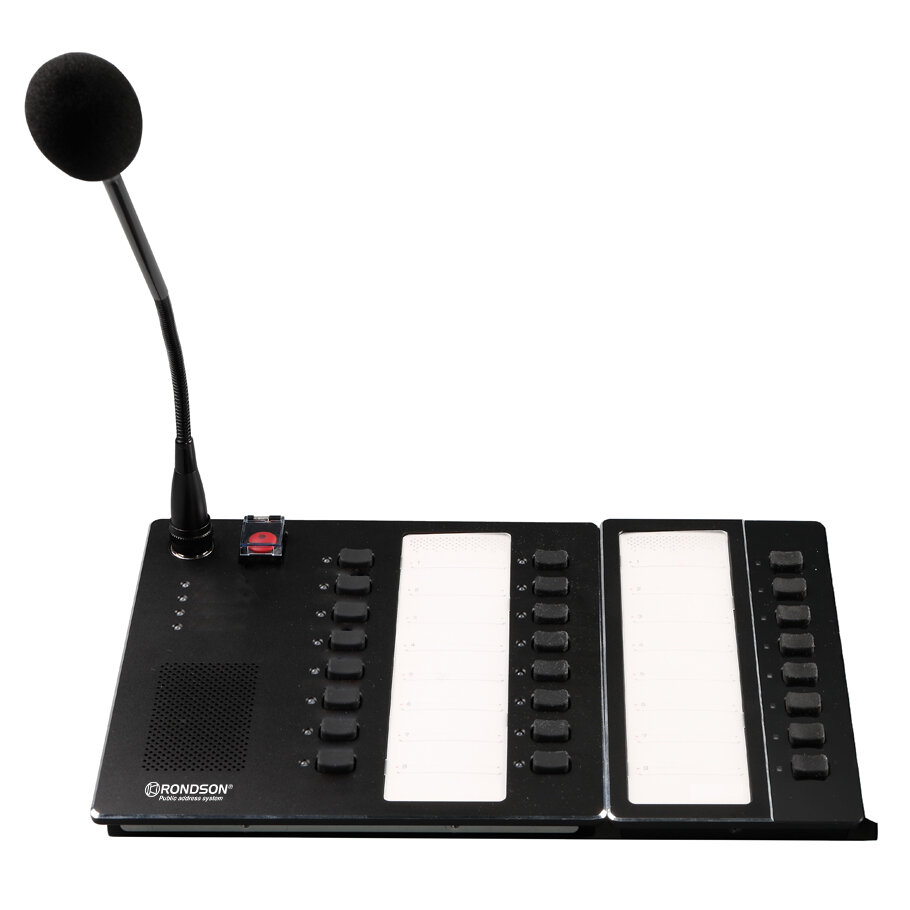
The EVA-MIC3000 call station is the point of contact between the operator and the system. It integrates a monitoring speaker, programmable buttons, temporary recording, line input for local sources and automatic supervision of the microphone and communication. The distance between the control unit and the station can reach 600 meters via CAT5 with external power supply, or 400 meters when powered directly from the control unit. Up to six call stations can be connected to the same system, allowing distributed management of zones and operating functions.
Cabling is one of the smartest aspects of the system. The call station, expanders and additional modules can be connected with a single CAT5 cable that carries audio, commands, supervision and power. The terminal blocks are organized by functional groups, further simplifying the installer’s work and drastically reducing errors, installation times and costs.
All this translates into a system that does not merely broadcast messages, but ensures that those messages always arrive, even in fault conditions.
EVA-3000M is designed to operate in a predictable, supervised and safe way, with an interface that guides the operator step by step in event management and problem diagnosis, an integrated solution that offers greater stability, lower costs, better user experience and high performance. This is what sets EVA-3000M apart from a normal distribution system: it is a safety platform that integrates logic, supervision, amplification, recording, diagnostics and zone management into a single compact, expandable device that complies with European standards.
Applications of EVAC systems and of the Rondson EVA-3000 in particular
EVAC systems are not intended only for large infrastructure or complex buildings: their operating logic, based on the broadcast of clear and intelligible voice messages, makes them indispensable in a wide range of everyday contexts.
Rondson EVA-3000, thanks to its compact architecture, full supervision and the possibility of expanding up to 128 zones, adapts perfectly to the needs of schools, offices, hotels and shopping centers, offering a single platform for evacuation management, internal communication and ordinary sound reinforcement.
In schools, day-to-day operation often relies on several separate systems: bells, message broadcasting, emergency communications. EVA-3000M makes it possible to centralize everything in a single platform, automatically managing end-of-class bells, supporting PPMS (Protection and Safety Plan) and allowing live announcements from several points in the building. Continuous supervision of lines, power supplies and connected devices ensures that the system is always operational, while the possibility of connecting up to six call stations over long distances simplifies the management of articulated campuses.

In offices, sound reinforcement is not only about safety but also about comfort and internal communication. EVA-3000M allows background music, informational messages and multi-zone announcements to be broadcast, with volume control adaptable to ambient noise. The advanced audio channel priority ensures that emergency messages immediately interrupt any content being broadcast. The aesthetic discretion of the Rondson devices in this series further facilitates integration into corporate environments.

In hotels, audio management is particularly complex: lobby, restaurants, spa, pools, conference rooms. EVA-3000M allows local sources to be assigned to each area, audio content to be scheduled throughout the day, up to 900 minutes of music to be stored and playlists and messages to be updated easily via USB or configuration software. In the event of an emergency, absolute priority for voice messages ensures that safety communications immediately reach all zones, with an intelligibility level suited to the different environments.

In shopping centers, operational simplicity is fundamental: high staff turnover, need to handle promotional announcements, multilingual communications, safety messages and music broadcasting. EVA-3000M offers an intuitive interface that reduces errors and simplifies training, allowing promotional messages to be programmed, playlists to be managed, background music to be broadcast and live announcements to be sent from dedicated paging stations. Constant supervision of lines and connected devices ensures that the system is always ready to handle critical situations, with absolute priority for evacuation messages.

Conclusions
In all the contexts we have examined, the Rondson EVA-3000 system stands out for its ability to combine ordinary sound reinforcement and voice alarm in a single certified platform, ensuring safety, operational continuity and ease of use. The system’s flexibility, expandability and full supervision make it an ideal solution for any building that requires clear, reliable communications in line with modern fire regulations.
Want to know more?
For more information contact your local agent or send an email to info@audioeffetti.it


