
 English
  French

The mixer is one of the key components of any audio system: it collects signals from microphones, musical instruments, and multimedia sources, routes them, mixes them — that is, sums them while controlling levels and tonal balance — and distributes them to the sound reinforcement system, the control room, recording systems, or streaming devices.
In this article we will revisit the essential concepts and examine the analog mixers available in the Audio Effetti catalogue, exploring their features, functions, and main application areas, with particular focus on models designed for PA systems and fixed installations.
From a small live event to a conference room and up to a large concert, the mixer represents the “heart” of a professional audio system.
In a market increasingly oriented toward digital technologies and network-based protocols, analog mixers still maintain an important role thanks to their immediacy, reliability, and robustness — essential qualities whenever direct and intuitive control is required. It is no coincidence that many sound engineers, even in high-end recording studios, continue to prefer analog consoles to achieve specific sonic results, despite their more demanding and costly maintenance.
Despite the widespread use of digital mixers, both in production and broadcasting as well as in live events, analog mixers therefore remain an extremely valid choice and by no means a fallback option in all those situations where a digital mixer would simply be… unnecessary.
Some examples? Small live events with a limited number of sources, bars, restaurants, shops, and commercial venues, situations where the system does not require presets, automation, or remote control, environments with non-technical personnel (volunteers, receptionists, entertainers, front-of-house staff), small-scale touring events or entry-level rental applications, limited budgets requiring absolute reliability, and many other similar contexts.
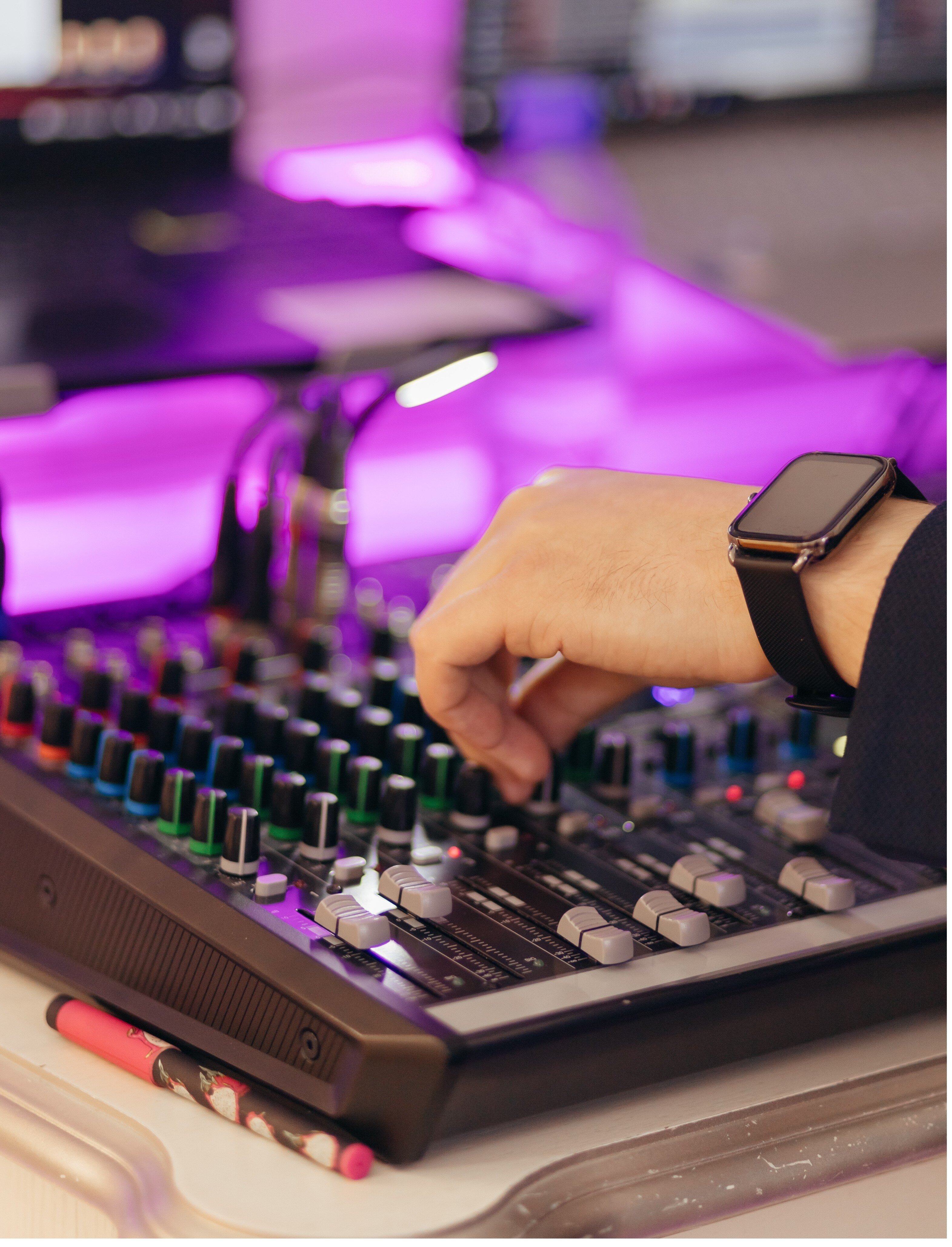
Channels, inputs, buses, auxiliaries… the essential concepts to know
To navigate the selection of a mixer, it is useful to recall some fundamental elements of its architecture:
- Channels: each channel manages an audio source, although some sources may require multiple channels. A drum recording setup, for example, may require 12–15 microphones. Conversely, a single channel may collect multiple instruments or voices, such as a violin section or a choir. Mono channels are dedicated to microphones and individual instruments, while stereo channels manage players, keyboards, or multimedia devices. Each channel includes a pan control, which allows the source to be positioned within the stereo image — an essential element for achieving a balanced and natural mix.
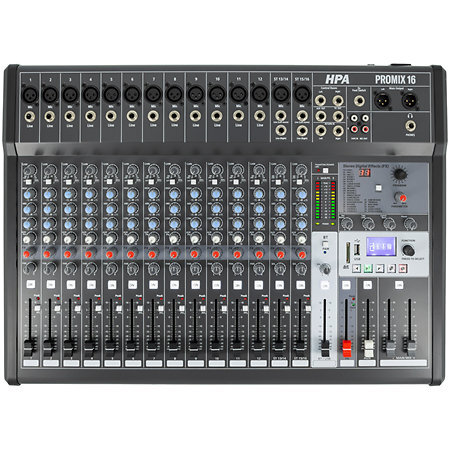
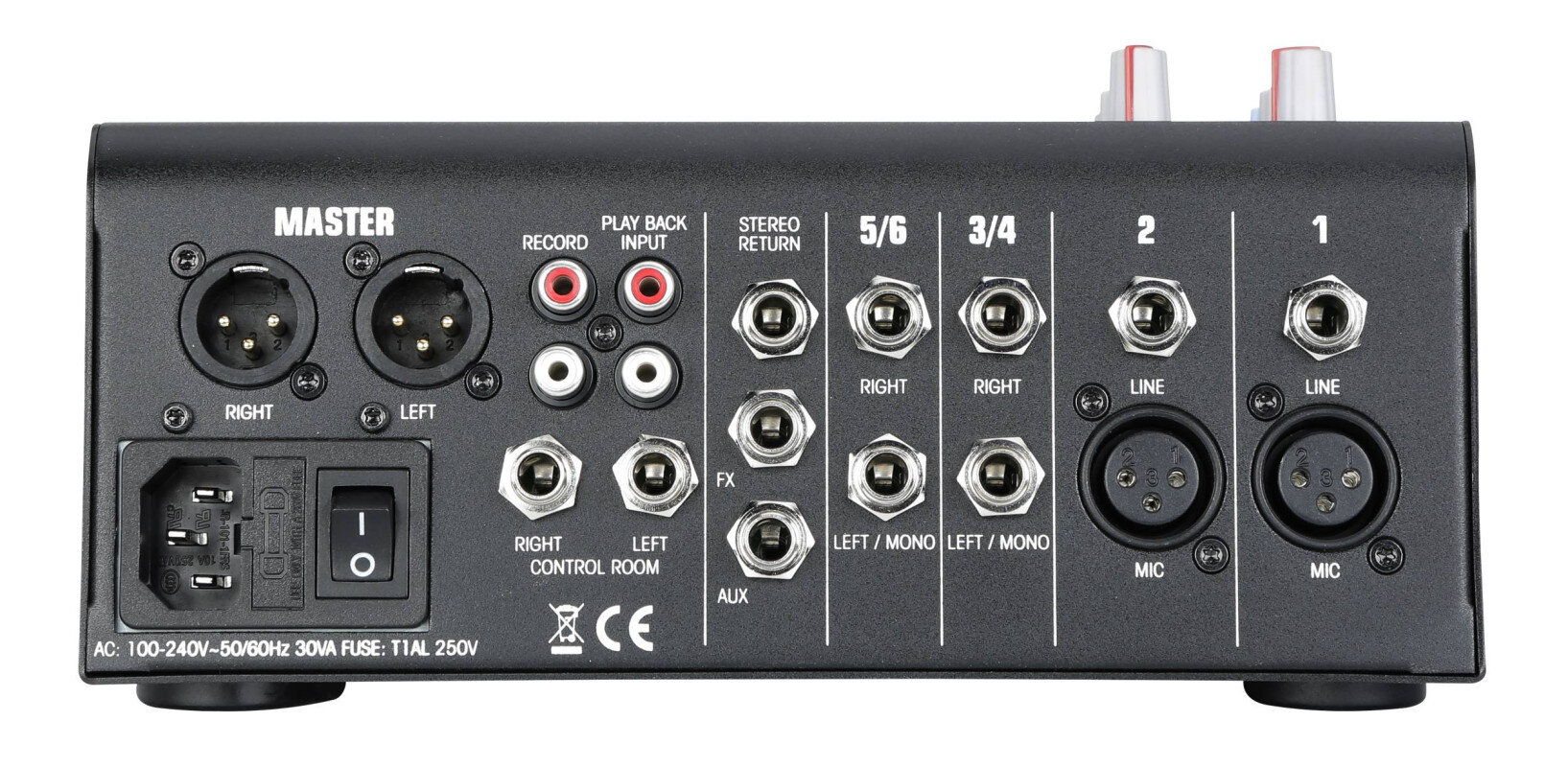
- Inputs: these are the physical inputs of the mixer. MIC inputs include a preamplifier and often +48 V Phantom power for condenser microphones; line inputs accept signals that are already preamplified. They may use XLR, jack, combo, or RCA connectors. It is important to distinguish between inputs and channels: two physical L/R inputs may constitute a single stereo channel, meaning that the number of channels is always equal to, or lower than, the number of inputs.
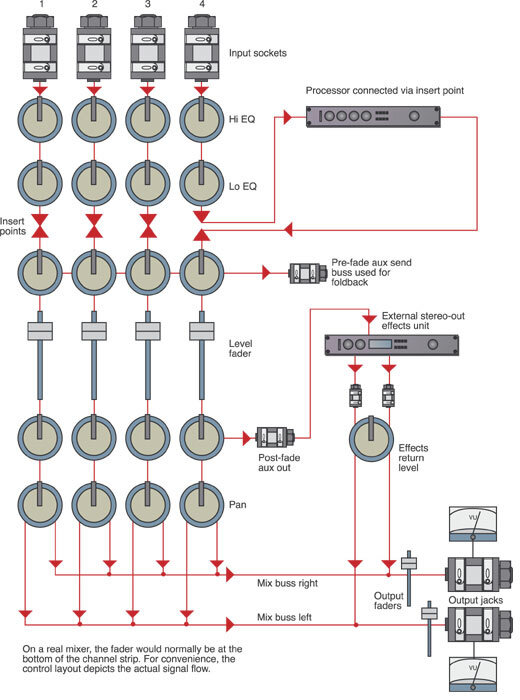
- Bus: a bus is a shared signal path: it collects audio from multiple channels and sends it to a common destination. It is essentially a summing line, where faders determine how much each channel contributes to the mix.
The main types of buses are:
-
- Main bus (or master): collects and sends the main mix to the sound reinforcement system.
- AUX bus (or AUX): sends signals to monitors, external effects, or additional zones. It is important because it allows musicians to listen — through stage monitors or in-ear monitors — to a mix that is independent from the main bus. Auxiliary sends can be pre-fader or post-fader. Pre-fader sends are used for monitors because they are unaffected by changes in the main mix; post-fader sends are ideal for effects, since they follow the channel level.
- Effect bus (FX): sends signals to the internal effects processor.
- Subgroup bus: allows multiple channels to be controlled together (for example, the entire drum kit or all vocal microphones).
- Insert points: an insert allows the signal from a channel to be routed to an external processor (compressor, gate, etc.) and then reinserted into the signal path after processing.
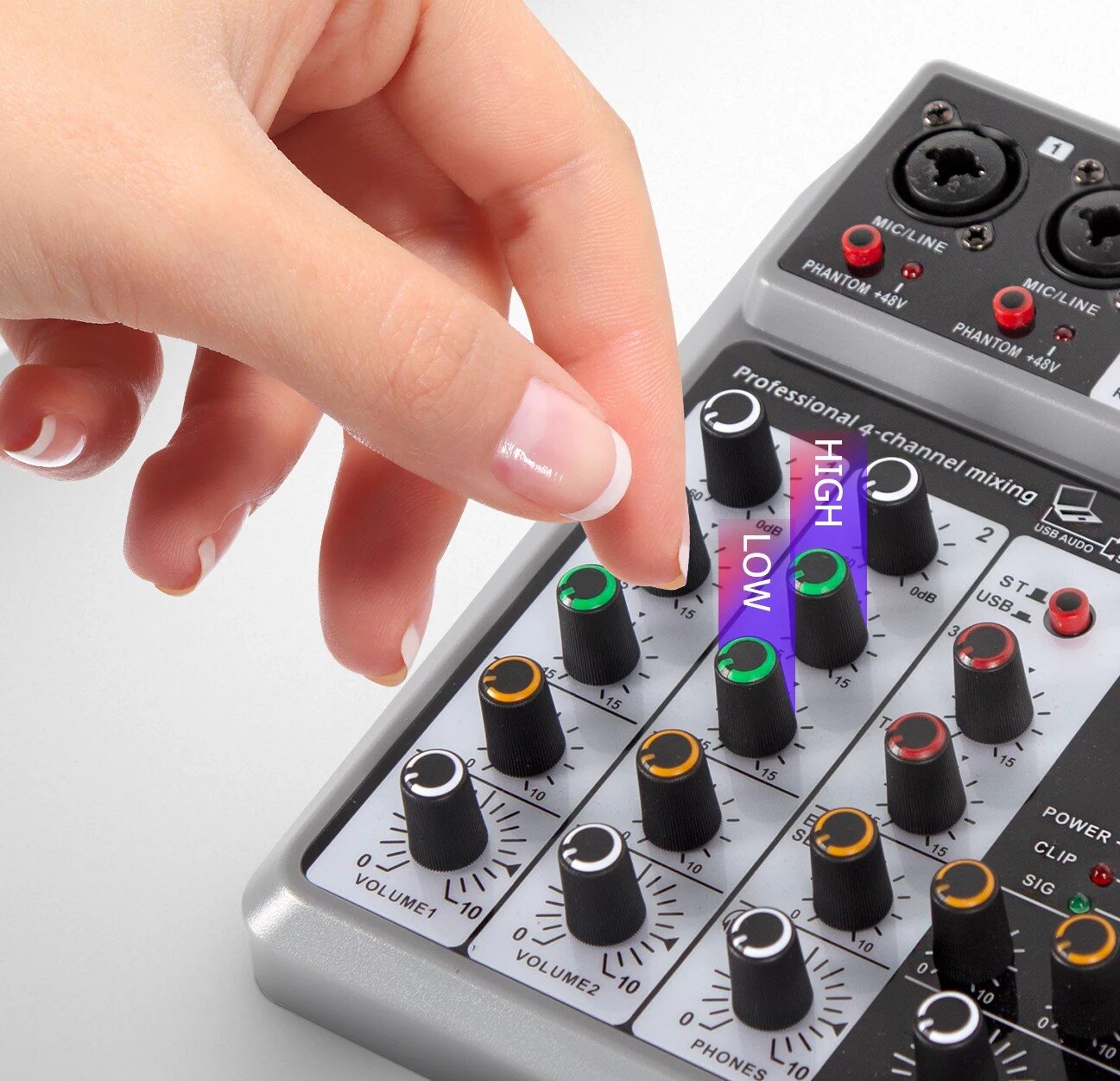
- Equalizers and dynamics: within the signal path of each mixer channel there may be graphic or parametric equalizers for tonal control, as well as dynamic processors such as expanders or compressors.
- CRM (Control Room Monitor): the CRM section allows the engineer to monitor the mix or parts of it without affecting the main output. It is designed for those who need to check what is happening in the system without altering what the audience hears.
- Recording output: this output is used to capture the mix (or part of it) in a clean and constant way, without affecting what happens on the master bus. It usually provides a fixed level, ideal for connecting external recorders, audio interfaces, or streaming devices, ensuring a stable signal free from accidental fader variations.
All these elements form the signal flow of the mixer — the path the signal follows from input to output through channels, equalizers, dynamics, and buses. Understanding this flow is essential for correctly interpreting how a mixer works and selecting the model that best suits specific needs.
“Digital” effects in analog mixers
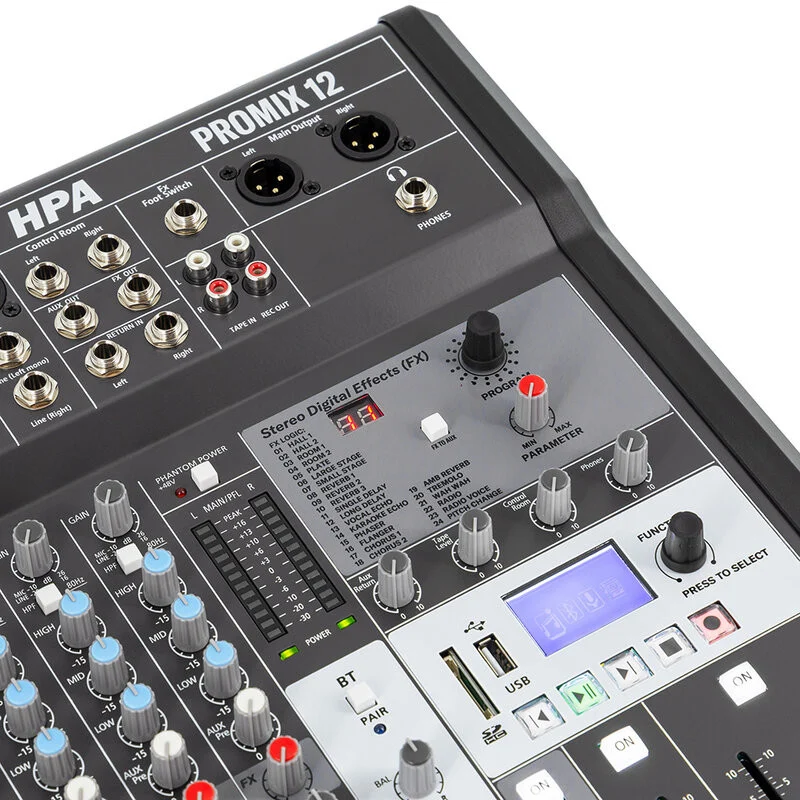
Many latest-generation analog mixers incorporate functions that until a few years ago were exclusive to digital models. These features significantly expand operational possibilities, making analog mixers extremely versatile tools even in modern environments where practicality, speed, and advanced functionality are required.
Internal effects processors: reverbs, delays, chorus, and other effects useful for vocals and instruments, instantly available without external hardware.
USB audio interfaces: enabling direct recording to a computer or sending the mix to streaming software.
Integrated multimedia players via USB, SD, or Bluetooth: ideal for background music, automatic playlists, or prerecorded announcements.
Alongside these digital functions, many mixers — especially those designed for installations — offer advanced features that improve system management while remaining fully analog:
-
Priority functions for paging microphones or emergency messages
-
Advanced routing with multiple outputs, independent zones, and dedicated controls
PA mixers
PA mixers include models designed for events, concerts, small performances, multifunction rooms, and conference rooms. They are versatile and reliable tools designed to provide immediate control in any live situation.
Below is a selection of the most significant models available in the Audio Effetti catalogue:
- Audiophony MPX16: a 16-channel mixer equipped with balanced microphone and line inputs featuring extended frequency response (10 Hz – 30 kHz on mono channels, 10 Hz – 55 kHz on stereo channels) and extremely low THD values, ensuring high sound quality. Mono channels include dedicated compressors and 3-band EQ, while stereo channels feature 2-band EQ. The internal effects processor uses a 24-bit converter and provides 16 programs. The unit also includes an integrated USB / SD / Bluetooth multimedia player and master and recording outputs with optimized impedances.
- JB Systems LIVE-10: a compact PA mixer with 10 inputs and 8 channels, equipped with an internal 32-bit DSP featuring 99 effects and a multimedia player capable of reproducing WMA, WAV, FLAC, APE, and MP3 files. It can also operate at 5 V via USB, making it suitable for mobile systems powered by power banks. It includes Bluetooth, USB recording and playback, balanced master outputs, and a headphones / CRM section with dedicated control. Mono channels feature individual Phantom power, pad, low-cut filter, semi-parametric 3-band EQ, and effects send. A 6-channel version is also available.
- Audiophony Mi6U: a compact 6-channel mixer with 4 microphone inputs equipped with +48 V Phantom power and 2 additional stereo inputs. Microphones use XLR connectors, while line sources are connected via jack. Channels offer bass / treble tone controls and rotary faders. The pre-fader AUX send includes dedicated controls for each channel and an AUX master. Outputs include balanced L/R main outputs on jack, REC output on RCA, balanced AUX output, and monitor output. A USB port is also provided for direct connection to a computer. LED VU meters allow immediate monitoring of the master level.
- Lone Audio LA-MIX8AM: this 8-channel model with MIC / line inputs differs from most competitors thanks to an integrated 2 × 160 W amplification stage, 32-bit DSP with 16 effects, and USB / Bluetooth multimedia player. It includes selectable +48 V Phantom power, 3-band EQ, trim, pan, FX, and linear faders for each channel. Outputs include balanced main and CRM on 6.35 mm jack, as well as a headphones output. The MP3 player features tone controls and dedicated faders, while the rear panel includes amplified outputs on speakON and jack connectors. It is supplied in a flight case and weighs 15 kg.
The complete range of distributed models can be viewed here: Audio mixers (including some DJ mixers).
Installation mixers
The main difference between a PA mixer and an installation mixer lies in their usage philosophy. Both mix signals, but they address completely different operational needs.
A PA mixer, as we have seen, is designed for live situations that are dynamic and variable: it must be immediate to use, with clear physical controls, linear faders, equalizers on each channel, auxiliary sends for monitors and effects, and often an integrated DSP processor.
An installation mixer, on the other hand, is designed for fixed systems such as restaurants, shops, hotels, schools, gyms, and public buildings. In these environments, flexible routing, microphone priority, multizone management, paging functions (voice announcements addressed to one or more areas with priority over background music), and remote control capability are required. For this reason, installation mixers are almost always rack-mounted, in one or more rack units, and in most cases use rotary faders rather than linear ones.
Here is a selection from our catalogue:
- Rondson PM 8P: an 8-channel preamplifier / mixer in 19” 1U rack format with selectable priorities, designed for fixed sound reinforcement systems. Each input includes volume control, MIC / line selector, low-cut filter, and Phantom power on channels 1–4 and 5–8. The front panel features tone controls, master volume adjustment, and LED signal indicators. Outputs include a balanced main output on XLR and an RCA output, as well as RS-232 and RJ45 connections for integration into complex systems. The NOMA function automatically adjusts the output level as active microphones increase, improving intelligibility.
- JB Systems MIX 5.2: a 19” 3U rack-mount installation mixer with 5 channels and 2 completely independent zones, ideal for shops, hotels, restaurants, and multi-room venues. It provides 11 inputs including microphones, line, and phono, with the possibility of assigning each channel to zone A, zone B, or both. Each channel features gain control, 3-band EQ, 45 mm linear faders, and peak indicators. The two zones include dedicated controls for tone, balance, volume, and mono / stereo selection, while the main microphone channel integrates adjustable talkover for priority announcements.
- Rondson T8000: an 8 × 8 audio matrix that also functions as a mixer, allowing levels, tone, and priority of each source to be adjusted before routing it to the various zones. It manages microphones, background music, and paging stations, assigning each input independently to one or more areas. The 8 outputs include dedicated controls for each environment. Priority logic, alarm functions, and integrated chimes ensure that announcements and important messages automatically override background music. The system can be expanded up to 40 zones via cascade connection and can be controlled from remote panels and microphone stations.
- Audiophony PA PREZONE444 MKII: an 8-channel installation mixer designed to manage up to 4 independent audio zones. Each input can be freely assigned and includes gain control, tone controls, and signal indicators, while the zones feature dedicated adjustments for volume and equalization. The system supports WP-1 remote panels for local volume and source control, as well as the MIC DESK4 console for selective announcements in the desired zones. A priority microphone with talkover and mute contacts for integration with external systems is also included. Equipped with dual power supply (AC / 24 VDC), it is ideal for installations in shops, restaurants, and public spaces.
Conclusions
Want to learn more?
Email us at international@audioeffetti.com


