
 English
  French

SFX controllers, that is, devices designed to manage scenic special effects in a safe, coordinated, and immediate way, are often seen as tools reserved for traditional pyrotechnics. In reality, they can also be used to great effect in live shows and television productions for advanced control of effects such as Sparkular cold sparks, CO₂ jets, stage fans, smoke/snow/bubble machines and, more generally, all those that use the DMX protocol. In this article we will see why a normal DMX console is not always the best choice, which characteristics set "modern" SFX controllers apart and how they integrate with the most common effect machines.
For industry professionals, and especially for those working in the world of professional pyrotechnics, an SFX controller is a familiar tool, being the command center that safely manages firing sequences, electric ignitions and even complex synchronizations. In that context its role is clear and well defined, because pyrotechnic effects, based on rapid chemical reactions, often with an explosive component, require rigorous procedures, real-time continuity tests and hardware protection systems against accidental activation.
Less immediate, however, is understanding why an SFX controller can also be useful when there are no pyrotechnic effects on stage and when the other effects are already controllable via DMX. It is a legitimate question: if Sparkular, flame machines, CO₂ jets, smoke, snow and bubbles are all DMX machines, why wouldn’t a normal lighting console be enough? Why introduce a dedicated controller when, in theory, a DMX desk can trigger everything?
We will look at this in more detail in the next chapter, but we can already anticipate the answer, which lies in the very nature of DMX: a unidirectional control protocol, designed to send values but not to receive feedback. The RDM extension introduces bidirectionality, but it is not widely used in the special effects world and, above all, it does not provide safety functions. DMX offers no operational feedback, does not include arming - that is, the ability to put the system into a "ready to fire" state without activating it - and does not protect against operator errors or unintended activations. These limits become particularly evident with certain categories of effects that, while not pyrotechnic, require a higher level of safety. This is the case with flame generators: they do not use explosive charges and are not pyrotechnics in the strict sense, but they employ combustible gases with controlled ignition and require safety and monitoring procedures similar to those of pyro systems. They therefore represent a true bridge between the two worlds: they do not belong to traditional pyrotechnics, but they cannot, and must not, be treated as simple DMX effects.
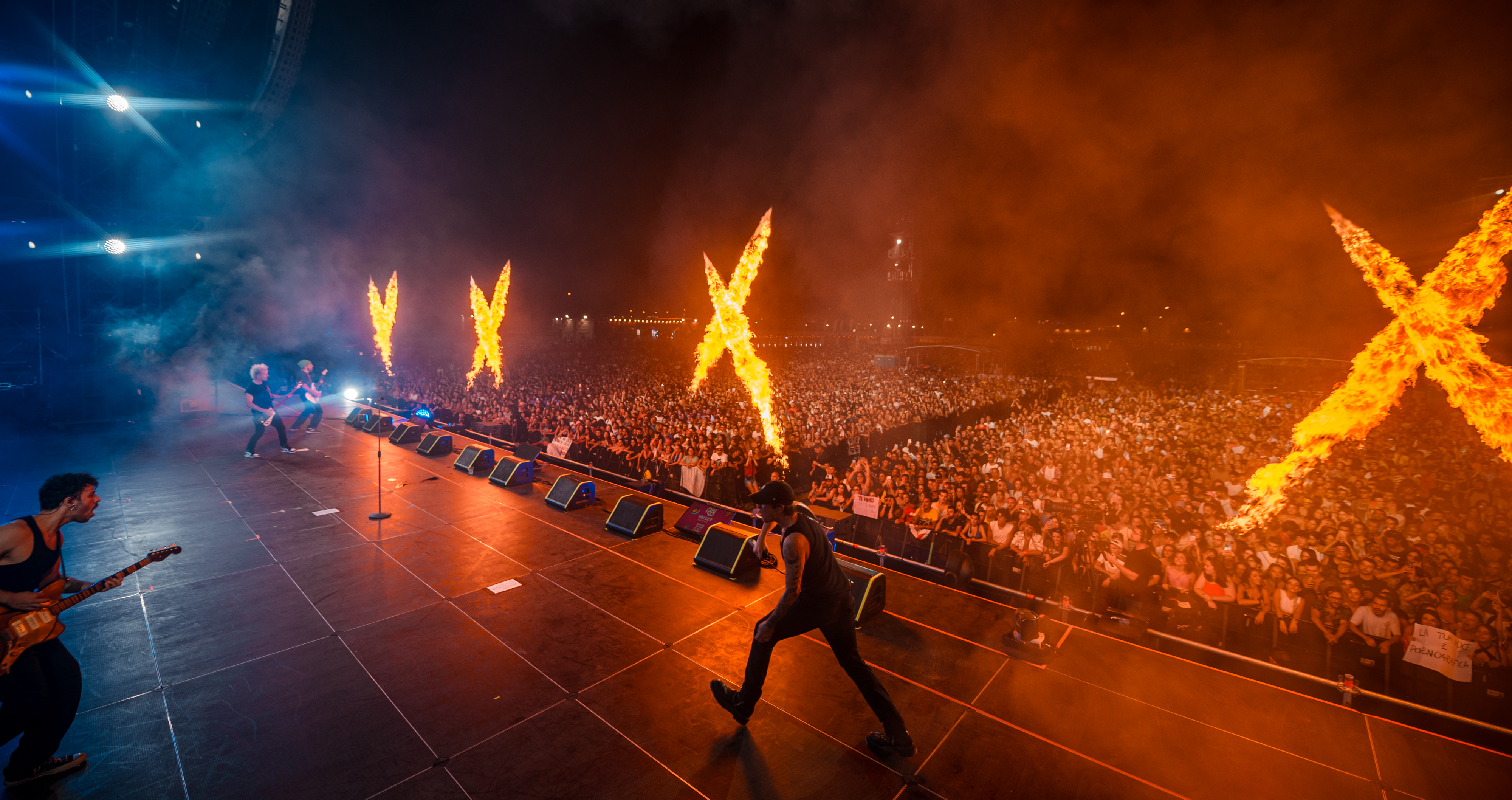
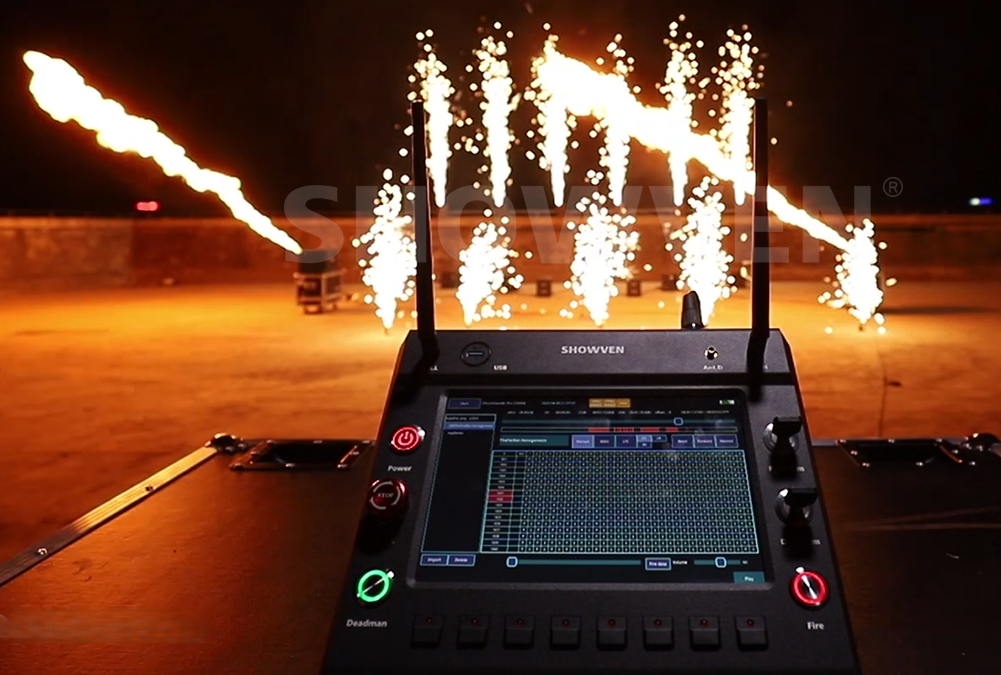
In real shows - festivals, TV, corporate events - these aspects become clear: you need a device that makes effect triggering immediate, safe, and centralized, regardless of whether it is flames, Sparkular sparks or atmospheric effects. This is where the latest generation of SFX controllers comes in: tools that do not replace DMX, but integrate it, offering a level of control better suited to contemporary stage effects and to the operational needs of today’s technicians.
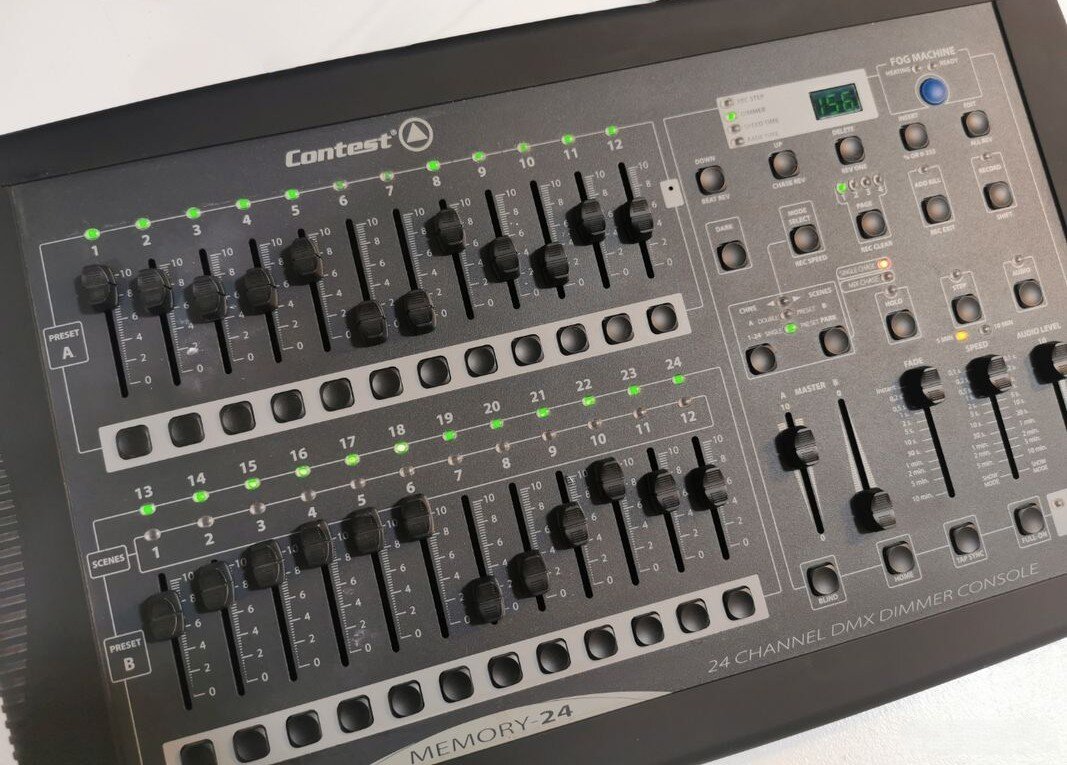
Why isn’t a DMX console enough?
Even when special effects are fully controllable via DMX, a control unit of this kind (in a general sense) or a lighting console is not always the most suitable tool for managing them during a show. This is not a technical limitation - DMX can trigger any machine - but an operational and safety one. Lighting consoles are designed to handle dozens or hundreds of fixtures, with complex pages, banks, cues, presets, and layers; in many contexts this approach is excessive compared to the needs of someone who simply has to trigger an effect at the exact moment it is needed.
In live events, television productions or corporate shows, effects are not always managed by the lighting designer. Often they are entrusted to a dedicated operator, a stage technician or a stage assistant who needs to intervene quickly, without navigating through programming pages or risking touching the wrong channel. A DMX console, however powerful, is not designed for a "safe hit" use: it requires a certain level of attention and a deep knowledge of the lighting project structure, exposing the show to the risk of accidental activations or missed fires.
There is also another aspect: stage effects do not always follow the same logic as lighting. A CO₂ jet, a Sparkular or an air blower must be triggered at very precise times, often in response to a sound cue, a performer’s gesture or a request from the director. In these cases, having a dedicated physical button, always in the same place, with a clear and immediate layout, makes the difference between a perfect result and a visible, costly mistake.
Finally, a lighting console is not designed to handle the specific workflows of certain types of effects: arming, lockout, dedicated pages, activation groups, rapid sequences, redundant controls. All functions that, while not strictly "safety" functions, make operation smoother and drastically reduce the chance of error.
In short, DMX is enough to control an effect, but it is not always the most practical tool for managing it in a real-world context. For this reason, in contemporary shows, SFX controllers have established themselves as the natural complement to the lighting console: they do not replace it, but lighten the load, making effect management more immediate, reliable, and suited to show timing.
When do SFX controllers come into play
SFX controllers represent the evolution of pyrotechnic control systems, but today they cover a much broader and more versatile scope. In addition to managing ignition lines for pyrotechnic charges (the electrical circuits that connect the controller to the igniters) or firing sequences, they are designed to safely, immediately, and centrally coordinate all stage effects, from the simplest to the most critical and complex.
In the Audio Effetti catalog, this "double soul" is clear. On one side there are traditional pyrotechnic controllers, such as Explo and Le Maitre, designed to manage electric ignitions, complex sequences and synchronized shows.
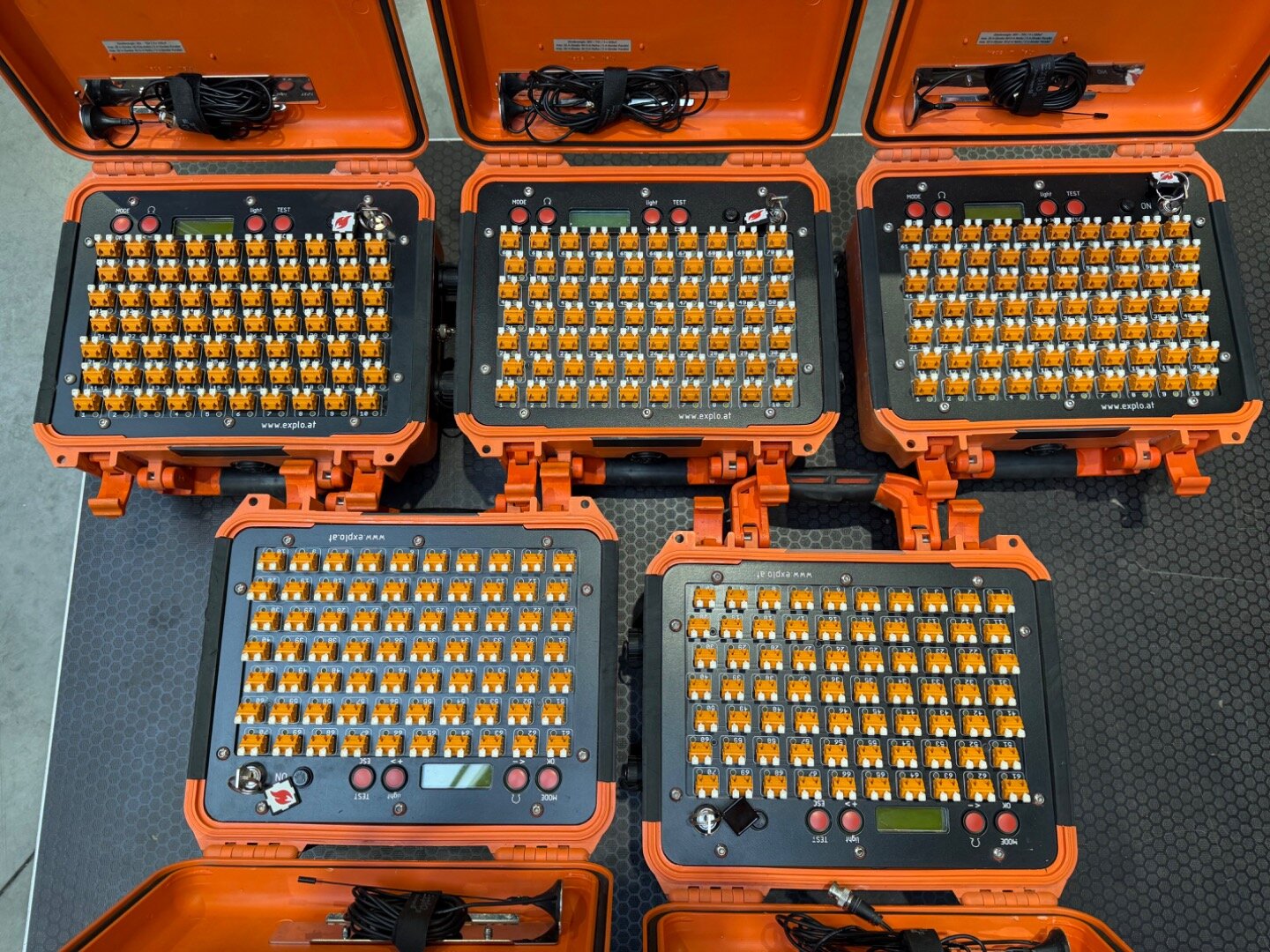
These latter do not trigger "generic fireworks", but professional pyrotechnic machines: launch tubes, comet and mine modules, systems for pyrotechnic fountains, airburst and Roman Candles, such as the Explo WS15 system.
On the other side, we find controllers dedicated to DMX effects, increasingly in demand from rental companies and professionals in live events, television productions and corporate shows.
These include products we will examine in more detail in the next chapter:
- SHOWVEN FXcommander, a hybrid console that combines DMX control and pyro line management, ideal for coordinating Sparkular, flames and other effects from a single advanced interface
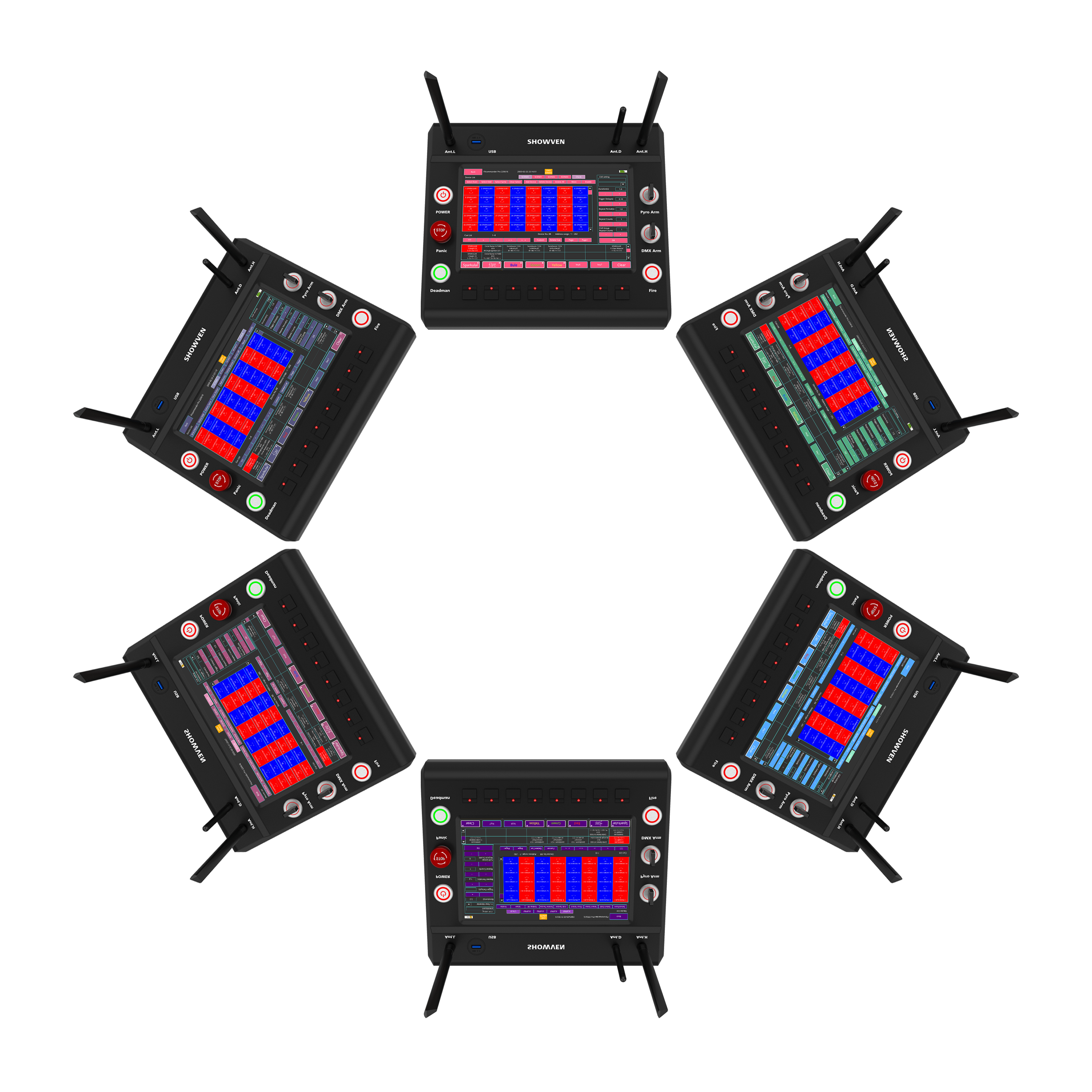
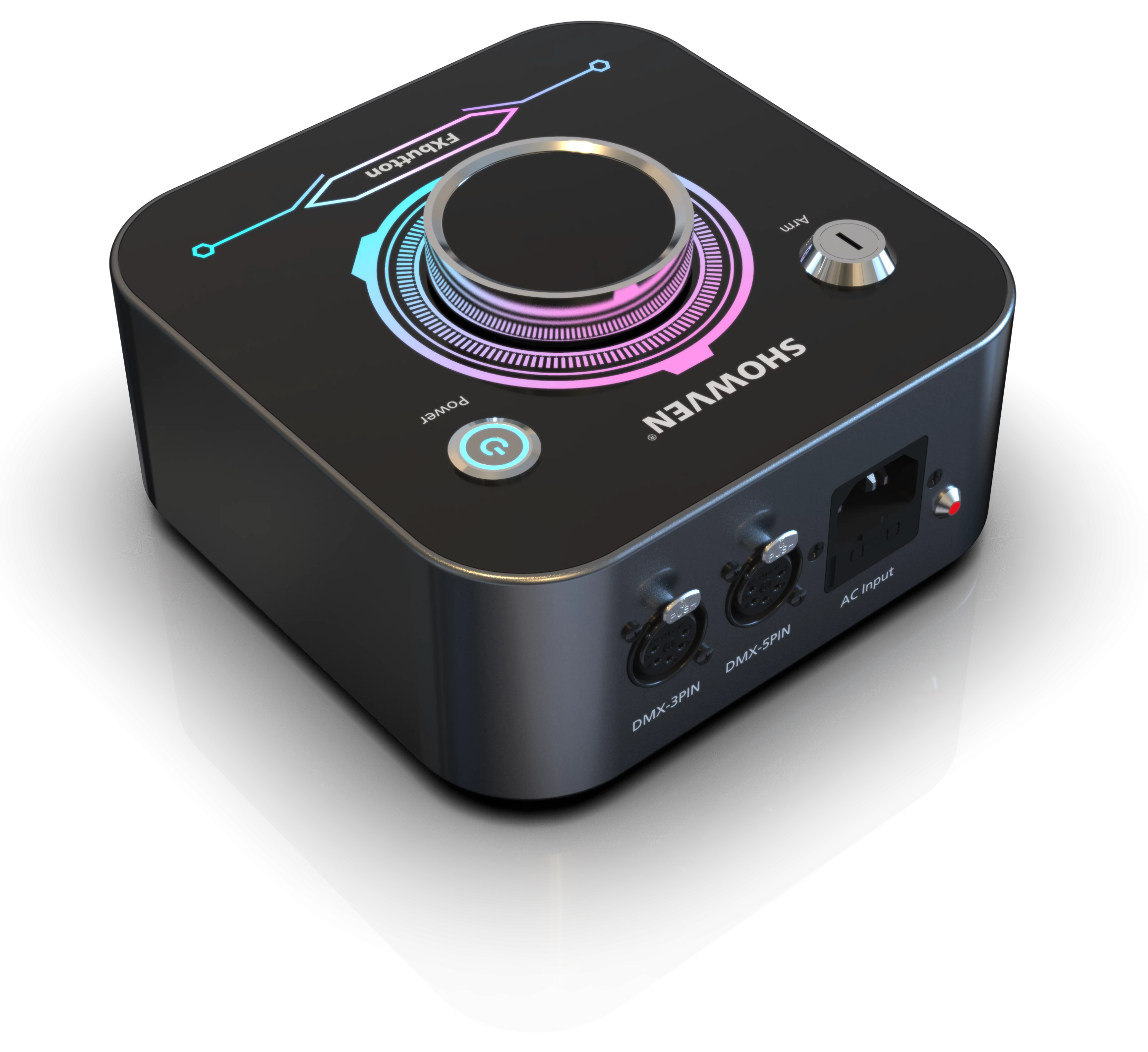
- SHOWVEN FXbutton, designed for fast, immediate DMX triggering, perfect for operators who need to react in real time with maximum responsiveness
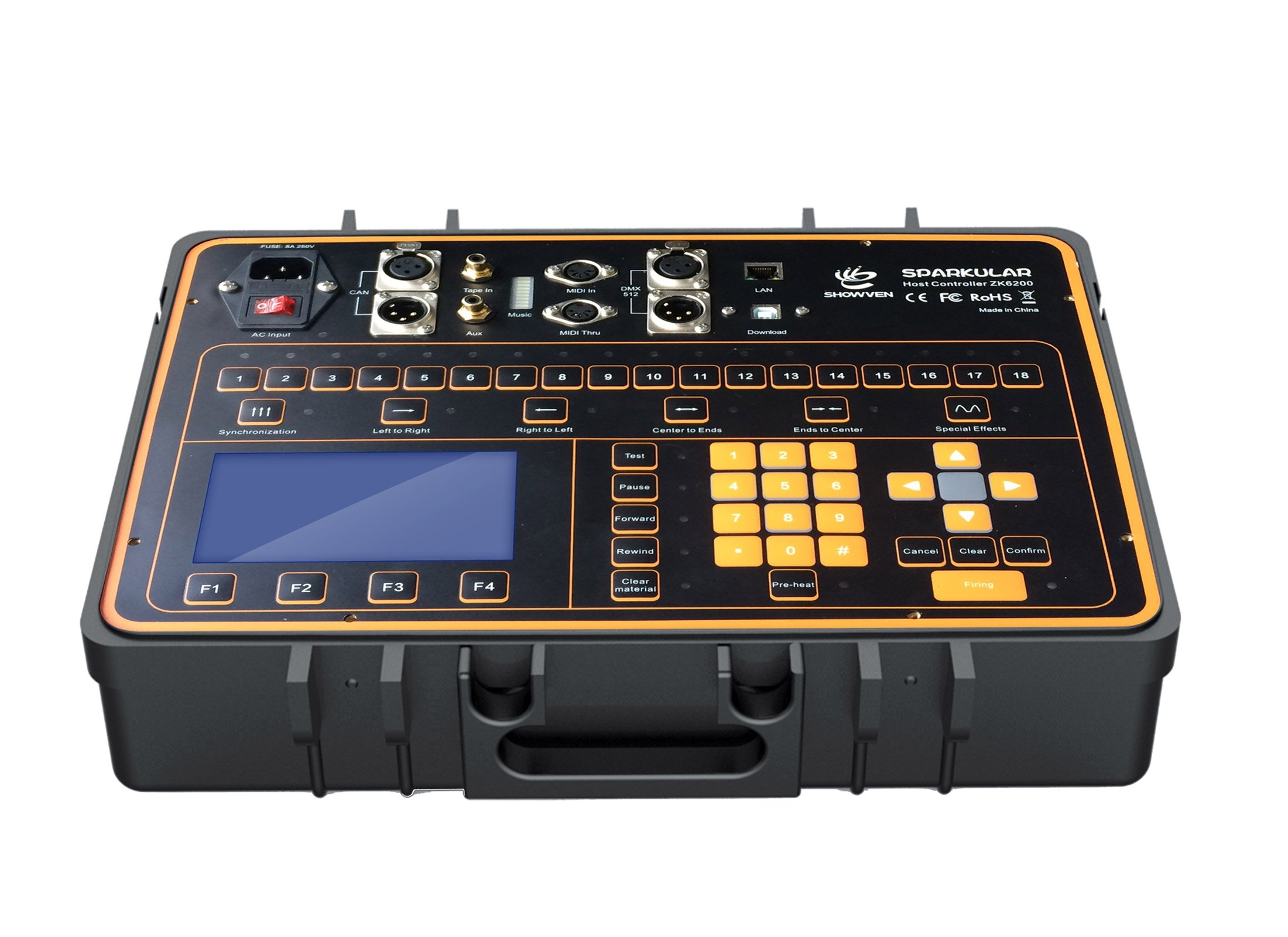
- SHOWVEN ZK6200 / ZK6300, host controllers designed specifically for Sparkular that centralize arming, machine status and triggering through bidirectional monitoring
- The Confetti Maker FX-Control, a 4-channel hardware controller for non-pyrotechnic effect machines such as CO₂ jets, confetti cannons and smoke machines
What all these products have in common is the operational logic: to simplify the operator’s work, guarantee infinitely safer control than pure DMX, and offer an interface designed exclusively for triggering effects, not for lighting programming. Functions such as arming, lockout, LED status indicators, activation groups and dedicated buttons make these controllers indispensable tools in modern shows, where precision, safety, and production reliability are fundamental.
Which controller should you use with different effect machines?
The choice of controller always depends on the type of effect to be managed and on the level of control required during the show.
For standard DMX effects, such as CO₂ jets, confetti cannons or smoke, snow and bubble machines, the priority is immediate and intuitive control, especially when the operator is not a lighting designer but a stage technician or stage assistant. In these cases, The Confetti Maker FX-Control is the most practical solution: four direct channels, dedicated buttons with safety switches and an essential interface that minimizes the possibility of error. This controller is perfect for corporate events, DJ sets, small live shows and all situations where you need a simple, reliable, and immediate device.
A separate discussion applies to traditional pyrotechnic shows or mobile installations that require maximum portability without giving up safety standards. In these scenarios, compact battery-powered solutions such as the Le Maitre Prostage 6 make it possible to manage up to 6 independent pyro channels with lightweight, robust hardware that is fully autonomous from the power grid, ideal for touring and productions on the move.
When the effects become more numerous or require a more structured control - such as Sparkular, flames or multiple sets of machines, even different ones - you need a controller that offers more advanced functions, such as arming, activation groups, dedicated pages and operation designed for this type of show. In this scenario, the SHOWVEN FXbutton is ideal for quick triggering of multiple DMX machines, while the SHOWVEN FXcommander is the most complete choice for television productions, festivals and shows where effects must be centrally managed.
For installations or shows that use a large number of Sparkular units, the SHOWVEN ZK6200 and ZK6300 controllers can manage 18 and 54 units respectively, centralizing arming, machine status and triggering in a single dedicated interface with real-time monitoring of temperature and pressure parameters.
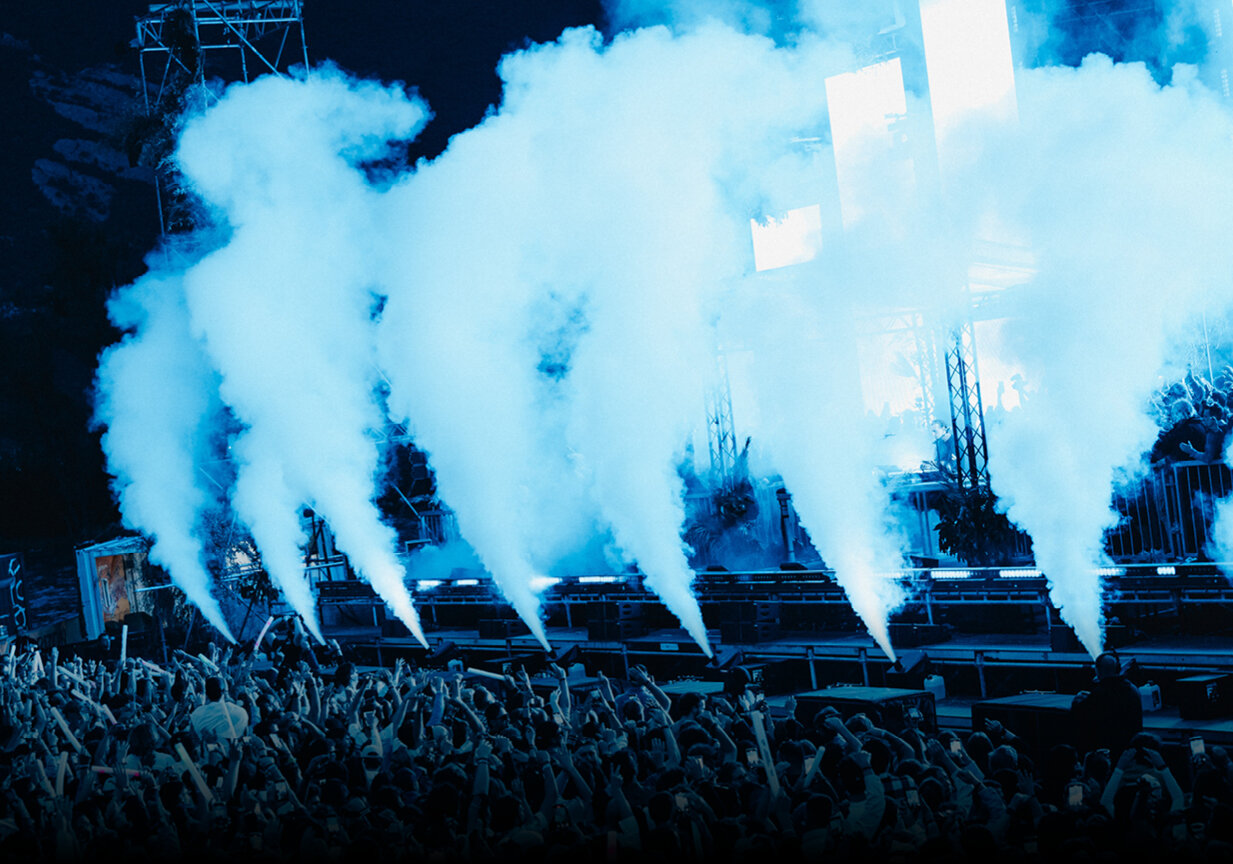
A separate discussion applies to mixed shows, increasingly common in modern productions, where Sparkular, flames, CO₂, and real pyrotechnic machines coexist. The integration between traditional pyrotechnics and special effects (SFX) represents the modern evolution of live entertainment. This synergy combines the visual power of classic fireworks with the millimetric precision of digital devices.
The real "brain" that enables integration between the two worlds is Time Code (SMPTE or MIDI). A single source (for example, the main audio track of a festival) sends the Time Code simultaneously to the lighting/DMX console (which controls flames and Sparkular) and to the pyrotechnic control unit (which controls the mortars).
The result? The exact millisecond when the drummer hits the snare, a gas flame bursts on stage and, at the same time, a pyrotechnic shot explodes 50 meters up in the sky.
In these cases you need a hybrid controller capable of managing both DMX and pyro lines, maintaining a coherent workflow and, above all, safety. The SHOWVEN FXcommander is the most versatile solution in the Audio Effetti catalog for this type of setup, because it allows you to coordinate effects of different nature from a single interface, reducing operational complexity and ensuring a higher level of safety and signal stability than management through a lighting console.
The FXcommander does not need external interfaces or to pass through a lighting desk to synchronize: it receives the sync track directly and starts the programmed sequences.
Conclusions
The integration between traditional pyrotechnics and digital special effects (SFX) represents the convergence of chemistry and computing in live events. As we saw in the introduction, until a few years ago fireworks and stage effects (flames, confetti, sparks) traveled on separate tracks. Today, technological fusion happens through a single, highly standardized direction.
In modern show design, the two worlds do not exclude each other, but create a perfectly coordinated "vertical" visual transition:
- The "Ground-to-Air" flow (from bottom to top): On stage, just a few meters from the performers, mobile flame machines (Wave Flames) or cold fountains are triggered. At the same moment, behind the stage (at a safe distance), colored smoke or pyrotechnic mines start up, extending the visual effect toward the sky.
- Chromatic synchrony: Modern liquids for flame machines make it possible to color the fire (green, red, blue). Designers integrate these colors with the chemical composition of aerial fireworks to maintain the same color palette throughout the event.
In these contexts, modern SFX controllers play a fundamental role, even though they do not replace the lighting console or DMX controllers, but complement them. They make it possible
to manage critical effects with greater simplicity and reliability, centralize operations that would otherwise require multiple devices, and offer operators a workflow that is faster, safer, and better suited to the needs of contemporary shows. Investing in dedicated hardware means raising the quality standard of your productions, eliminating margins for error and ensuring maximum safety for the crew and the audience.
Want to know more?
For more information, contact your local agent or send an email to info@audioeffetti.it


