
 English
  French

Since the introduction of DMX512, stage lighting—and far beyond—has undergone a significant transformation. In this article, we will explore why traditional DMX is no longer sufficient for complex installations, how Art-Net and sACN operate, the advantages they offer in terms of scalability, reliability, and data management, and how technologies such as RDM are revolutionising fixture configuration and diagnostics.
DMX512 was introduced in the 1980s as the standard protocol for lighting control in the entertainment industry. It is simple, robust, and universally supported, making it one of the most widely adopted control standards. A DMX system consists of a serial communication line, a controller, and a chain of devices connected in a daisy-chain configuration (that is, one after another along a single DMX line, from the controller to the last fixture terminated with a 120-ohm resistor), supporting up to 512 channels per universe.
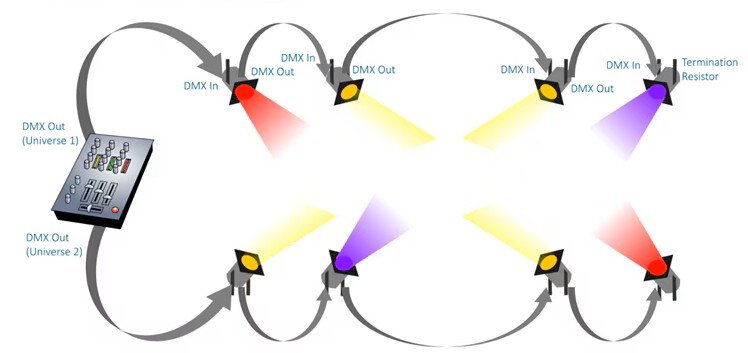
With the evolution of lighting fixtures, however, the limitations of the DMX architecture have become increasingly apparent…
- Only 512 channels per universe, which can quickly be exhausted by moving heads and complex LED fixtures, each requiring a large number of channels.
- A maximum of 32 devices per line, beyond which splitters and repeaters are required.
- A data rate of 250 kbit/s, adequate in the 1980s but somewhat restrictive by today’s standards.
- A maximum cable length of approximately 300 m.
- A unidirectional protocol: the controller sends commands, while the fixtures simply receive them.
- Susceptibility to interference and dependence on cable quality.
When a single fixture can require 80–100 channels, a DMX universe is quickly consumed. Add pixel mapping and architectural lighting installations, and it becomes clear that a more flexible solution is needed.
Consider, for example, a simple 80-pixel RGB LED bar. Controlling the red, green, and blue channels requires a total of 80 × 3 = 240 channels. This means that every two LED bars will almost completely occupy a DMX universe. If additional fixtures need to be connected, further DMX outputs must be used, increasing overall system complexity.
Whether it is a large installation with numerous fixtures or a smaller setup featuring fixtures that each consume a significant number of DMX channels, once the four-universe threshold is exceeded, cabling becomes increasingly complex (unless Wireless DMX is used). More importantly, troubleshooting and fault isolation can become significantly more challenging.
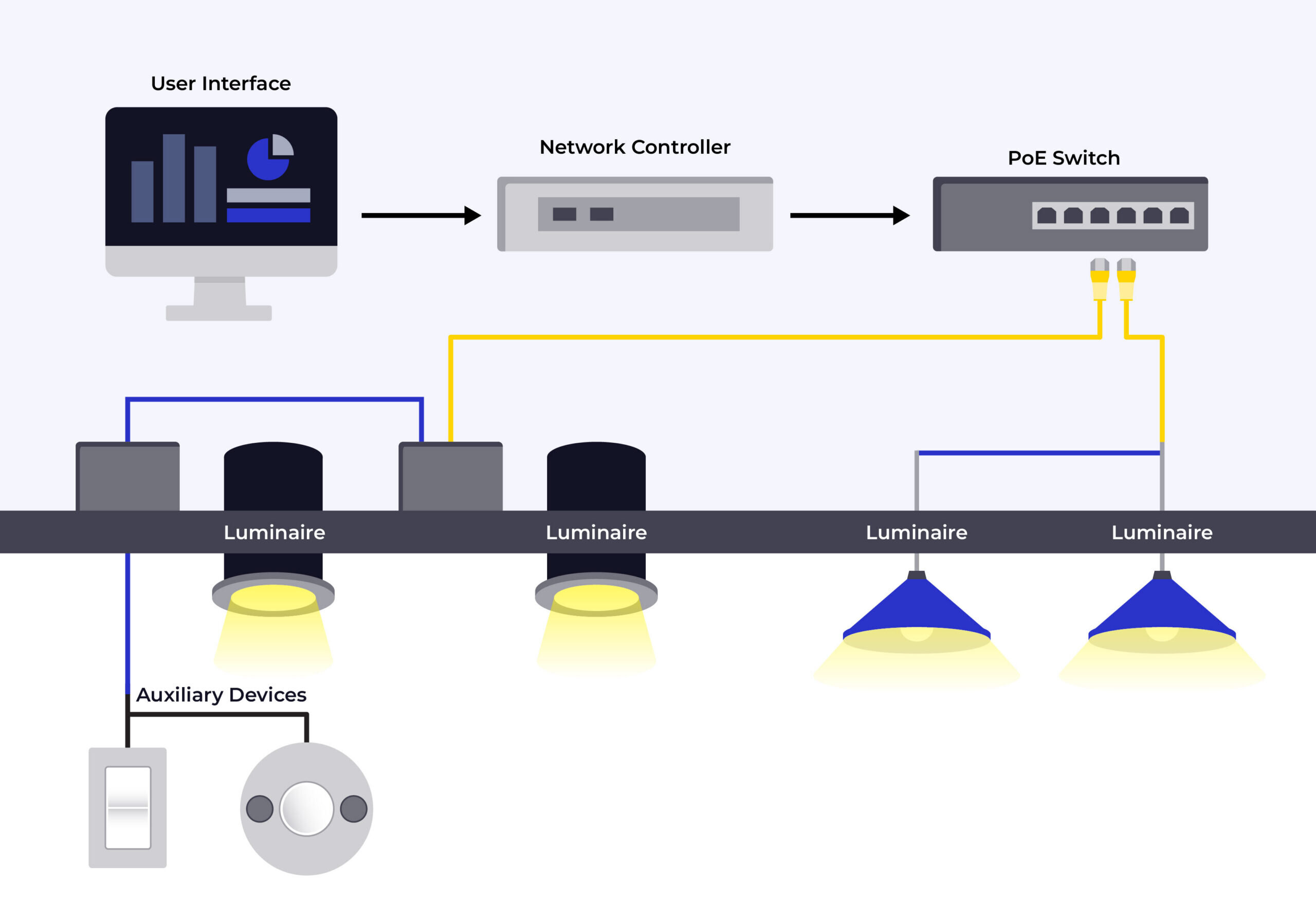
Why move to network-based lighting control?
Ethernet networking is not simply “faster”; it is an infrastructure specifically designed to transport large volumes of data in a reliable and scalable manner, while supporting far more flexible topologies than a traditional DMX bus.
Moving lighting control onto a network offers several advantages:
- The use of standard network cables (Cat.5/6/7), which are cost-effective and widely available.
- The ability to leverage switches and routers to create star, ring, and redundant network topologies.
- The capacity to transport tens of thousands of universes over a single network backbone.
- The possibility of covering long distances using fibre-optic connections.
- The option to power nodes and gateways via PoE (Power over Ethernet).
- Seamless integration of the lighting system with existing IT infrastructure.
In practice, networking eliminates many of the physical limitations of DMX, making it possible to design larger, cleaner, and easier-to-maintain lighting systems. Dedicated cables no longer need to run directly from the console to the stage, as the console can connect to the venue’s network infrastructure from virtually any location. Art-Net or sACN nodes that convert network data into DMX can then be positioned directly near the fixtures—on trusses, poles, or wherever they are most convenient.
It is important to note that the transition from DMX to networking is not an “all-or-nothing” process. Thanks to nodes and gateways, traditional DMX lines can continue to be used where required, while only the main backbone is migrated to a network-based infrastructure.
Art-Net: the most widely adopted DMX-over-IP protocol
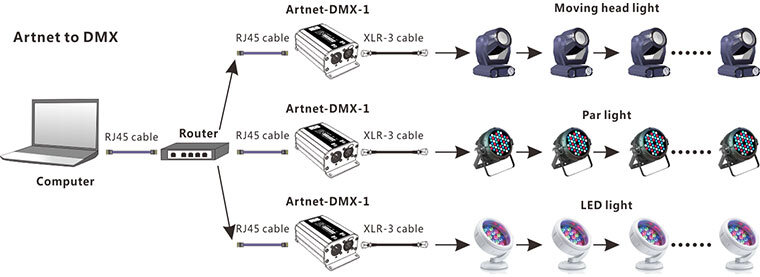
Art-Net encapsulates DMX frames within UDP packets and transmits them over an Ethernet network. Each DMX universe becomes an IP data stream that can be distributed to one or multiple nodes.
In simplified terms:
- The lighting console generates DMX data, or alternatively Art-Net data directly. In the former case, a gateway is required to convert DMX into Art-Net.
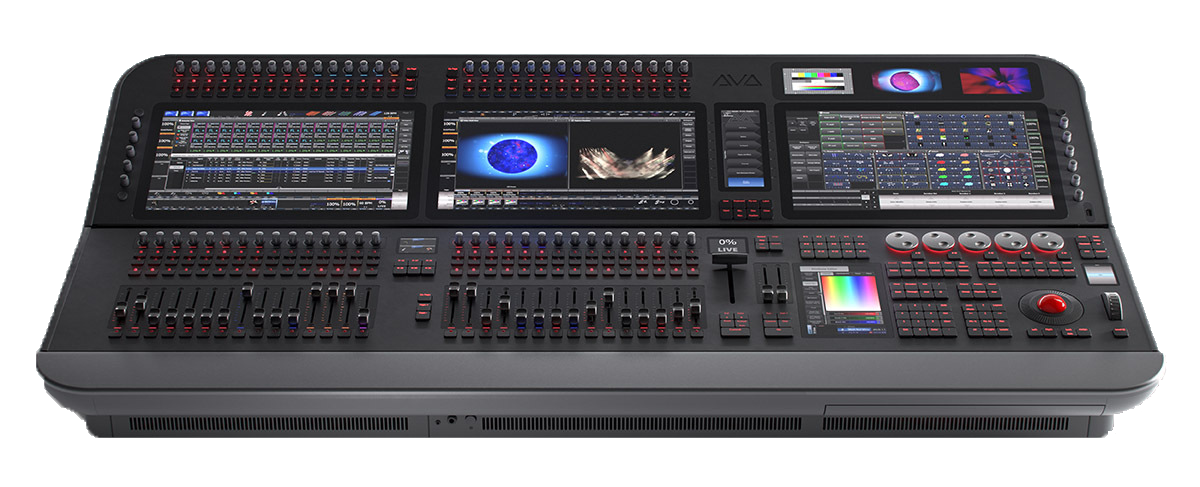
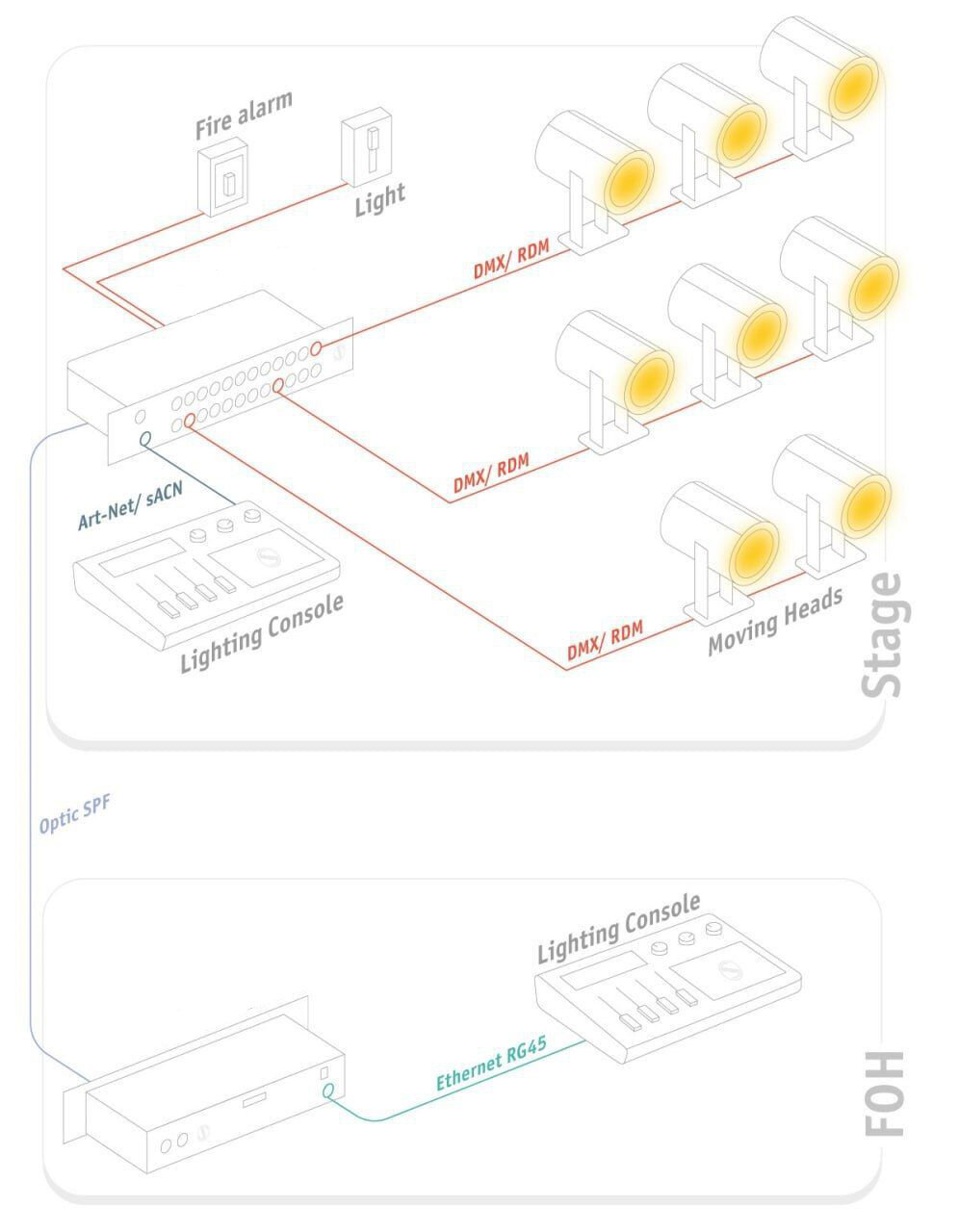
- The packets travel across the network infrastructure (network cables, switches, and fibre-optic links). Notably, the Avolites D9 lighting console is currently the only console on the market equipped with a 1 GB Quad opticalCON LC fibre-optic port, allowing direct connection to the Titan Net Switch (a network switch featuring fibre connectivity) and enabling the deployment of a fully fibre-based lighting network.
- Art-Net nodes convert the network packets back into physical DMX signals for the lighting fixtures (or, as we will see later, some fixtures can receive the Ethernet data stream directly without requiring DMX conversion).
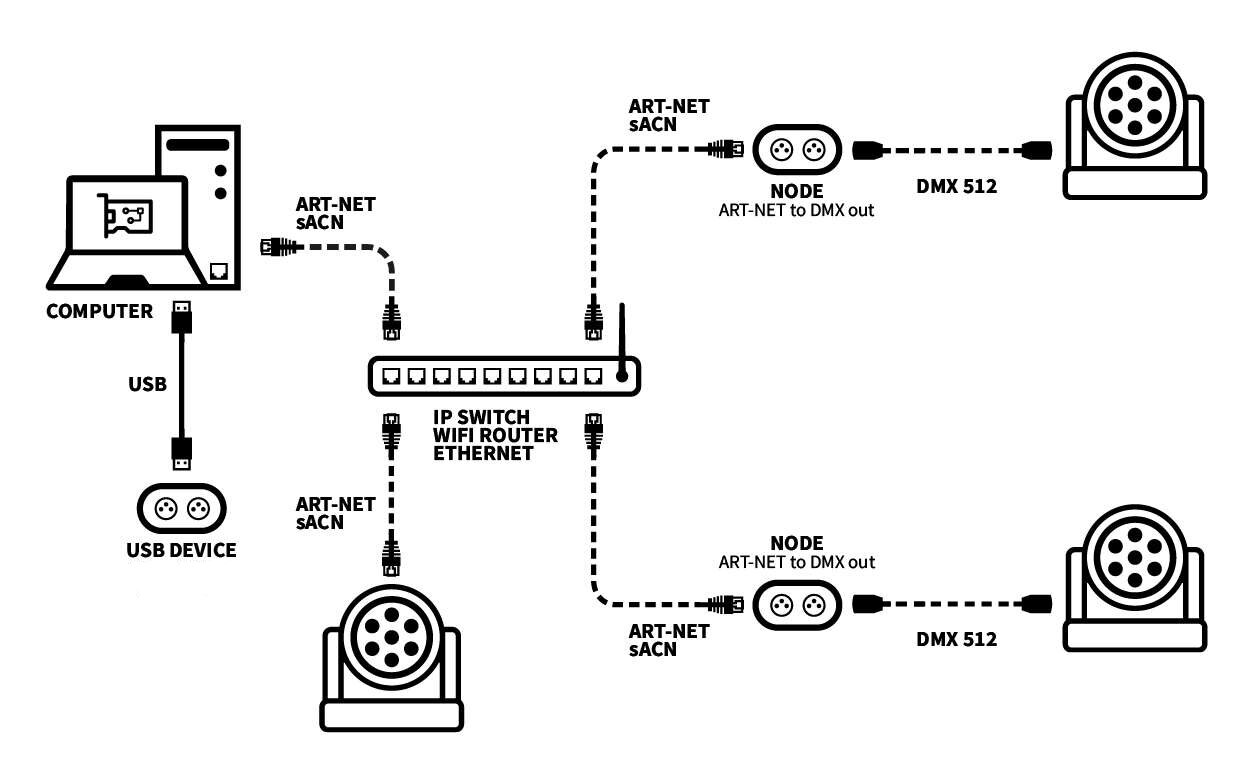
In other words, the Art-Net signal generated by a lighting console (or a PC) is transmitted via a standard network cable to an unmanaged switch, typically the simplest and most cost-effective solution. From the switch, the outgoing ports route the packets to the Art-Net nodes within the system and, from there, to the fixtures being controlled.
The programmer simply needs to assign the correct IP addresses to the devices or use the default addresses preconfigured according to the Art-Net standard.
The vast majority of Avolites lighting consoles support native Art-Net output, further simplifying system deployment and reducing cabling requirements:
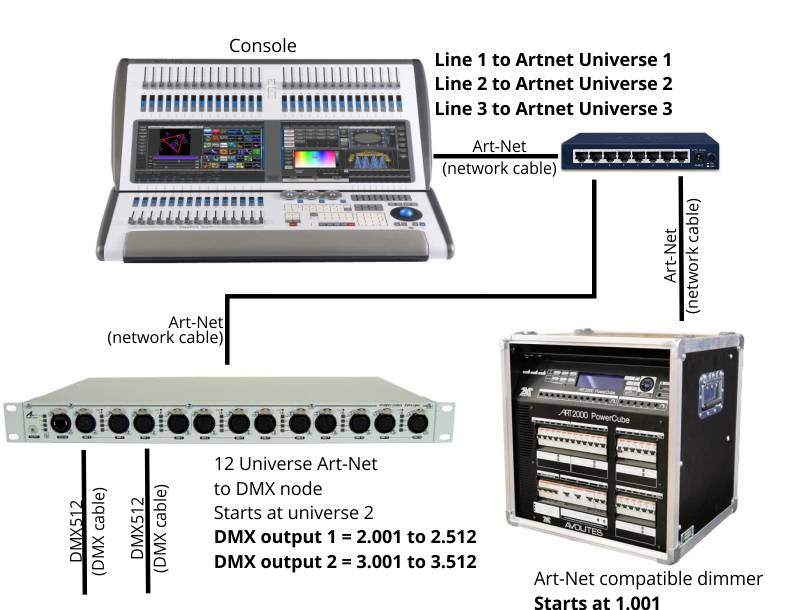
All Art-Net nodes typically use IP addresses within the 2.x.x.x or 10.x.x.x ranges, with a subnet mask of 255.0.0.0, as defined by the protocol specification. IP addresses consist of four octets, while the subnet mask determines which devices can communicate with each other within the same network. In essence, the same principles that govern standard Ethernet networks apply, but with recommended address ranges designed to minimise conflicts with the venue’s existing IT infrastructure.
Key features of Art-Net
- Supports tens of thousands of universes on a single network (Art-Net III / IV).
- Broad compatibility with lighting consoles, software platforms, and third-party nodes.
- Relatively straightforward configuration, including IP addressing, universe assignment, and transmission mode settings.
- Support for RDM-over-IP through compatible nodes.
- Well suited to live production environments where flexibility and rapid deployment are essential.
When does it make sense to choose Art-Net?
Art-Net is often the most natural choice when:
- Working with lighting consoles and software that support the protocol natively.
- Integrating devices from different manufacturers.
- Managing live events, touring productions, and festivals where compatibility is a key requirement.
- Looking for a smoother learning curve when transitioning from traditional DMX to network-based lighting control.
A well-designed range of Art-Net nodes and gateways makes it possible to build reliable and easily expandable lighting networks. Among the products available in the Audio Effetti catalogue is the Briteq BT-NODE24 Mk2 (5-pin XLR), a device featuring four configurable DMX ports with support for both Art-Net and sACN.
sACN (Streaming ACN): the modern and scalable standard
sACN (ANSI E1.31) is a protocol developed by ESTA for transporting DMX data over IP networks. It is part of the ACN (Architecture for Control Networks) family, which was designed for advanced control of lighting devices and other networked systems.
From the outset, sACN was engineered to be:
- Scalable: supporting up to 65,535 universes.
- Efficient: making extensive use of multicast transmission.
- Robust: capable of managing multiple data sources through a priority-based system.
- Synchronized: allowing multiple universes to be synchronised for demanding and mission-critical applications.
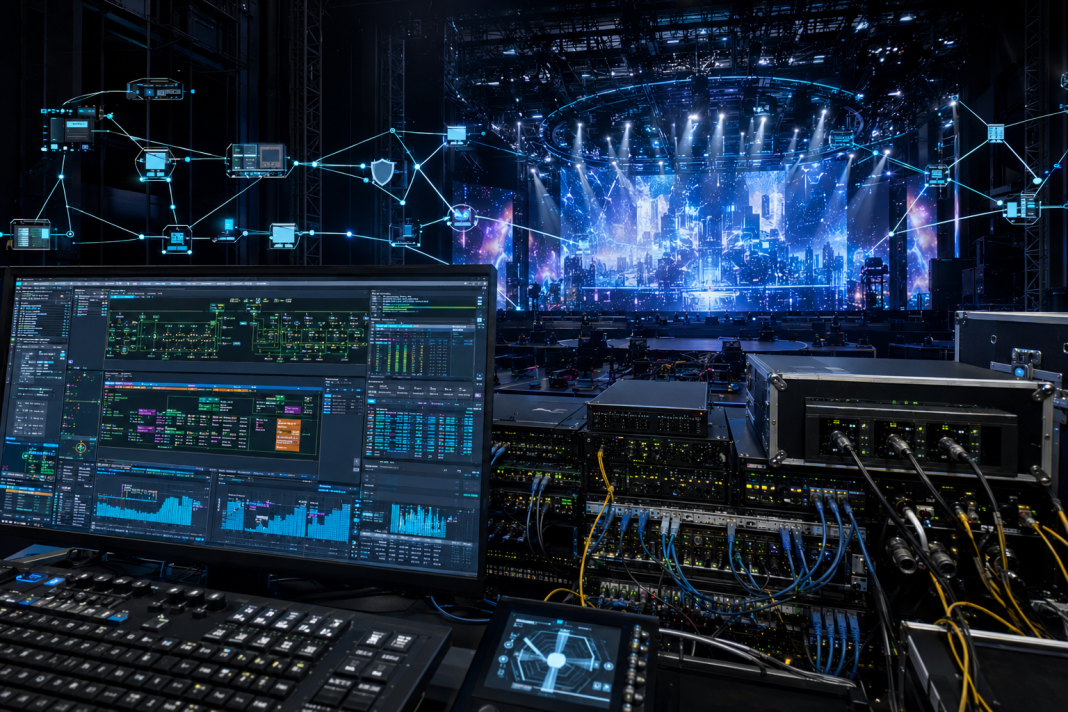
Multicast is one of the key strengths of sACN. Rather than flooding the network with broadcast traffic, sACN allows nodes to “subscribe” only to the universes they actually require. In practice, each sACN universe corresponds to a specific multicast address, and fixtures subscribe to that address using IGMP. It is essentially as if the fixture tells the network switch, “I want to receive this stream,” and the switch forwards only the packets associated with that particular universe.
This approach significantly reduces network traffic and makes the system far more efficient, especially in large-scale installations.
From a practical standpoint, in an sACN-based system:
- One or more sources (lighting consoles, media servers, or controllers) transmit DMX data over sACN universes.
- The data travels across the IP network, typically using multicast transmission.
- Receivers (nodes, fixtures with network connectivity, and servers) subscribe to the multicast addresses corresponding to the universes they need to receive.
- If multiple sources transmit data on the same universe, the priority system comes into effect, with the source assigned the highest priority taking control.
This mechanism is particularly valuable in systems that employ a primary and backup console, in scenarios where a media server and a lighting console share control of certain fixtures, and in permanent installations where redundancy is a critical requirement.
RDM: when DMX finally talks back
RDM (Remote Device Management) is an extension of DMX that introduces bidirectional communication. While traditional DMX operates as a one-way “monologue” from the controller to the fixtures, RDM transforms it into a dialogue.
With RDM, the controller can:
- Identify connected fixtures, including model information, device ID, and firmware version.
- Configure DMX addresses and operating modes remotely.
- Read status parameters such as temperature, error conditions, and operating hours.
- Receive notifications when issues occur, such as a failed light source, a blocked cooling fan, or other system faults.
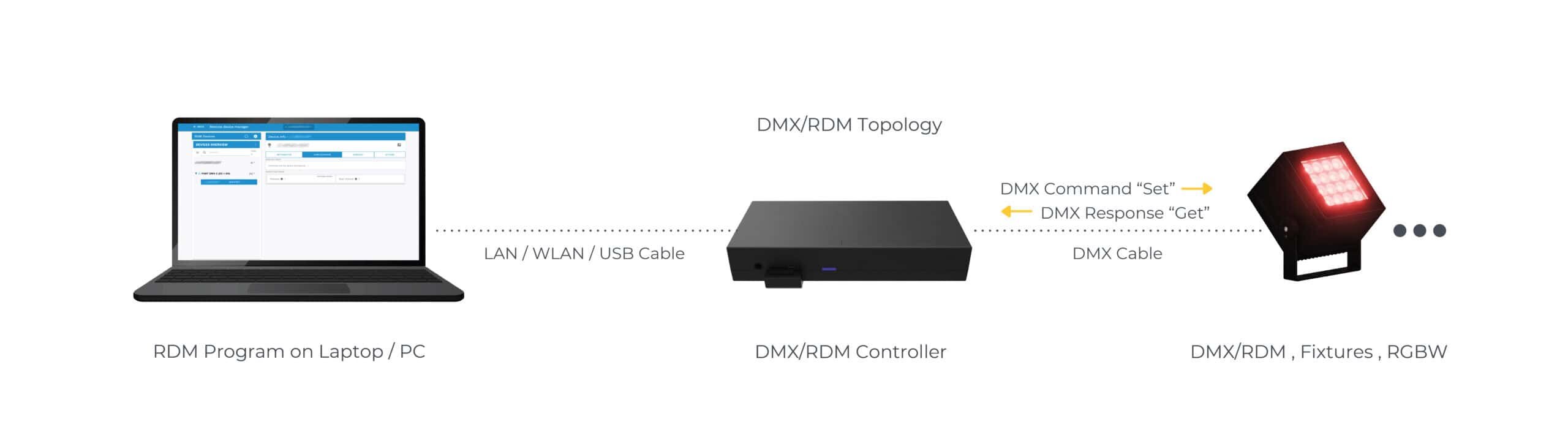
At this point, a natural question arises: if RDM is an extension of DMX, what does it have to do with network-based transport?
RDM was originally developed for physical DMX networks, but today it is often carried across Ethernet infrastructures through nodes and gateways that bridge RDM-over-DMX on the field side with protocols such as Art-Net or other remote management mechanisms on the network side.
In a properly designed system, it is therefore possible to:
- Control fixtures via DMX.
- Manage and diagnose them through RDM.
- Transport all of this over an IP network using suitable nodes and gateways.
An example of a two-port network node supporting RDM, Art-Net, USB 2.0, and a DMX-512 interface is the MADRIX STELLA, as well as the eight-port STELLA 8 version with RDM support.
The Visual Productions RdmNode, on the other hand, is a device specifically designed for bidirectional communication between controllers and DMX devices, making it particularly useful for configuring, monitoring, and diagnosing fixtures without requiring physical access to each unit.
Also worth mentioning are the Briteq DMS-283 RDM and DMS-285 RDM, which combine DMX merger, splitter, and booster functionality with the ability to filter RDM traffic, helping to prevent unexpected behaviour from DMX devices.
Network control... directly at the fixture
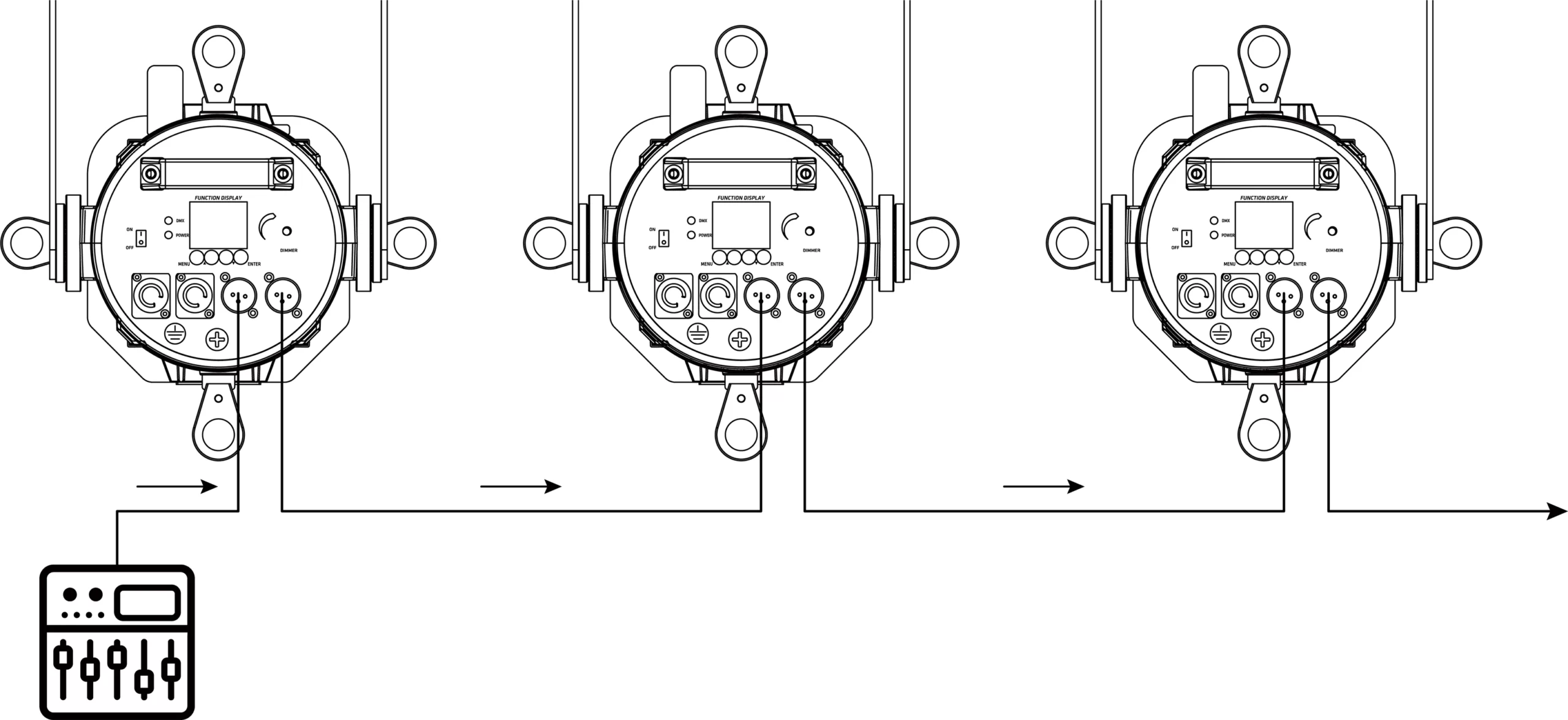
The advantages are immediate: fewer DMX cables to install, greater flexibility in fixture placement, the ability to manage a large number of universes without splitters or boosters, and more advanced diagnostics thanks to status information available over the network. In sACN-based systems, fixtures can also subscribe to multicast universes via IGMP, receiving only the data they require and thereby reducing overall network traffic.
This native integration is particularly valuable for lighting devices with a high channel count—such as pixel-based LED bars, multi-zone wash fixtures, and RGBW strobes—where a single fixture may require hundreds of control channels. In permanent installations, theatres, television studios, and large live events, fixtures equipped with network connectivity make it possible to fully leverage the scalability of Art-Net and sACN while maintaining compatibility with traditional DMX lines through gateways whenever required.
In summary, fixtures with Ethernet connectivity represent the next natural step in the evolution of lighting control: more flexible, more scalable, and easier to integrate into modern network-based infrastructures.
Audio Effetti distributes several fixtures featuring network connectivity for Art-Net and sACN. One example is the tarm BLAZE laser-powered moving head fixture, which supports Art-Net, RDM, sACN, and W-DMX. Another noteworthy moving head is the Briteq BTI-BLIZZARD WASH2s, which, in addition to offering 133 DMX channels, provides full support for both Art-Net and sACN.
For pixel-mapping applications, the Briteq BTX-LIGHTSTRIKE LED bar combines DMX with RDM support and full Art-Net/sACN compatibility, enabling the creation and control of large-scale lighting setups quickly and efficiently.
Finally, in the architectural lighting category, the SGM PALCO 3 supports all major control protocols, including DMX (also available in wireless configurations), RDM, Art-Net, and sACN.
Comparison between Art-Net, sACN, and RDM
The table below summarises the main differences between the three protocols (or, in the case of RDM, the protocol extension):
|
Feature |
Art-Net |
sACN (E1.31) |
RDM |
|---|---|---|---|
|
Technology type |
DMX-over-IP |
DMX-over-IP |
Physical DMX extension |
|
Supported universes |
|
Up to 65,535 |
n/a |
|
Transmission |
Multicast / Unicast |
Multicast / Unicast |
|
Conclusions
Want to learn more?
Email us at international@audioeffetti.com


