
 English
  French

The PALCO family from Danish manufacturer SGM represents one of the leading benchmarks in the rental, touring and live entertainment industry, where high light output, colour saturation, compact dimensions, low weight and durability are key factors. These fixtures share a common foundation built on a range of proprietary technologies — TruColor®, DynaMix®, VersaPath® and ThermalDrive® — designed to ensure calibrated and uniform colour mixing, high output performance, intelligent thermal management and extended component lifetime. These technologies are complemented by a unique calibration process, unmatched within the industry, which guarantees absolute colour consistency across different units, even years apart and between different production batches.
The choice of Lime colour (instead of White…)
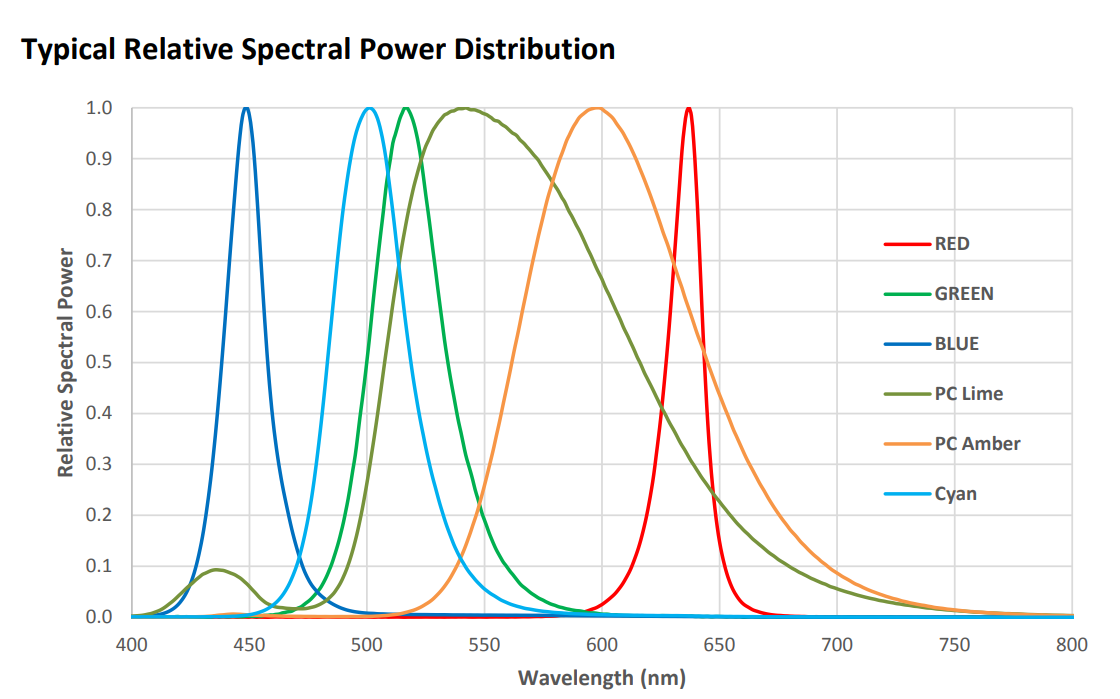
The use of Lime as a fourth “additional primary colour” is one of the distinctive features of the SGM PALCO family. Unlike white LEDs, which provide a fixed and non-adjustable emission spectrum, Lime offers a broader and spectrally richer output, positioned within the area of the human eye sensitivity curve where light perception reaches its maximum (see graph below).
The main advantage is that Lime dramatically increases luminous efficiency without compromising colour quality. While a white LED tends to flatten colour mixing and reduce colour saturation, Lime works in synergy with red, green and blue, expanding the usable spectrum and improving the rendering of warm and neutral tones.
In practical terms, Lime makes it possible to achieve more natural calibrated whites, with smoother dimming curves and greater consistency across different colour temperatures. In addition, thanks to its superior spectral efficiency, PALCO fixtures deliver higher illuminance levels at the same power consumption while maintaining more visible saturated colours (through SGM’s colour boost technology called DynaMix®, as we will see later) and a more uniform overall output.
TruColor®, the science of perfect colour mixing
DynaMix®, real output power on every colour
VersaPath®, intelligent colour correction
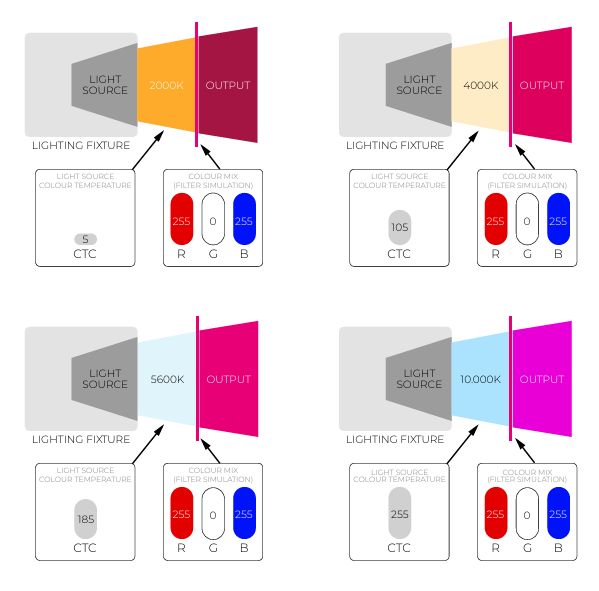
VersaPath® is an algorithm that introduces advanced control over the colour path, allowing the hue of any RGB mix to be adjusted by acting directly on colour temperature data. Through a single DMX channel (CTC), it becomes possible to ensure that a mixed colour maintains a precise point within the spectrum, effectively simulating the behaviour of traditional gel or glass filters used in theatre lighting.
When this colour path is used, even filter emulation presets respond dynamically to colour temperature variations, providing a much more refined level of control compared to standard RGB mixing alone.
This technology makes it easy to match PALCO fixtures with luminaires from other brands, achieve subtle yet essential colour variations and manage colour temperatures from 2000 to 10,000 K without compromising uniformity. It is an especially valuable feature in mixed installations or whenever a more “theatrical” look is required while still using modern LED fixtures.
Products equipped with the new-generation VersaPath® colour engine also include SGM’s proprietary standard mixing algorithm, ensuring both full compatibility with the SGM colour palette and broader, more precise creative control.
ThermalDrive®, stable output in every condition
ThermalDrive® is SGM’s proprietary system designed to intelligently manage active cooling and drive currents through a continuous feedback circuit based on temperature and fan speed sensors positioned at the fixture’s critical points. This control system is calibrated to keep LEDs and sensitive components consistently within manufacturer specifications, regulating temperature across different areas of the unit and intervening only when necessary.
If maximum thermal thresholds are reached and the cooling systems are already operating at their limits, ThermalDrive® gradually reduces output, preventing sudden drops in performance or abrupt thermal protection shutdowns.
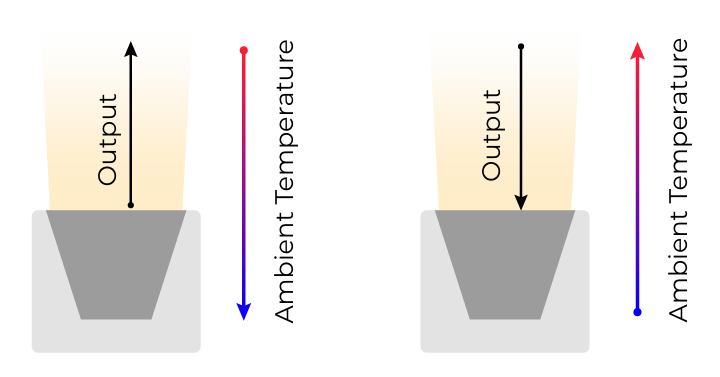
Unlike many manufacturers of architectural fixtures that do not use active cooling — or implement it with only a limited number of sensors — SGM employs an advanced system featuring multiple monitoring points and sealed fans specifically designed for outdoor applications. This approach makes it possible to achieve exceptionally high output levels relative to fixture size, while also ensuring longer component lifetime.
There is an additional advantage: the fixture can be cooled both through the onboard fans and via the internal heatsinks, allowing heat dissipation to take place silently when required by switching the fans off.
ThermalDrive® software also stabilises light output by preventing fluctuations caused by environmental changes. When temperature rises, power is reduced smoothly and predictably, while output is progressively restored as temperatures decrease. The result is a consistently stable and continuous light beam, even under the most demanding operating conditions.
Colour calibration
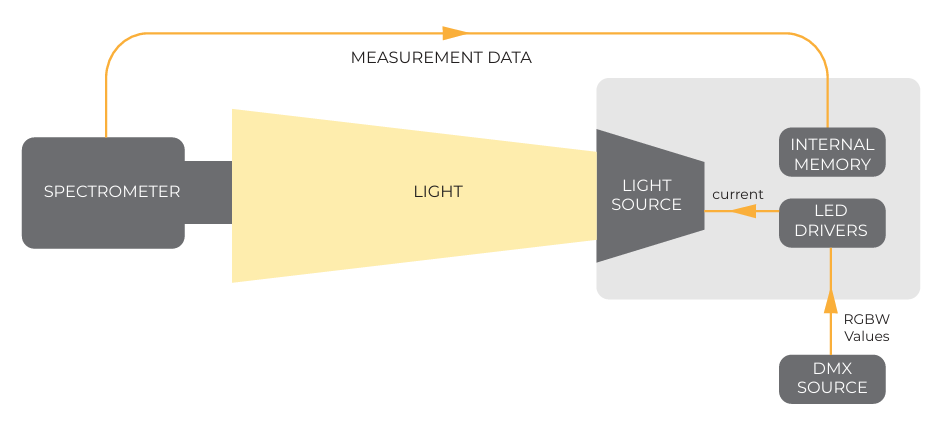
Thanks to this process, the fixture “knows” the actual characteristics of its LEDs and drivers, making it possible to reproduce colours with a level of precision that cannot be achieved with non-calibrated systems. The TruColor® algorithm uses this information to interpret DMX values and generate exactly the hue requested by the lighting designer, automatically compensating for tolerances, temperature variations, current fluctuations and component ageing.
The result — and this is worth emphasising once again — is absolute colour consistency across different units, different production batches and even different fixture models and generations (for example PALCO and P5).
Why is calibration so important? As we know, a lighting console outputs three RGB parameters that can consist of either 256 values (8-bit) or 16,384 values (14-bit). These values are interpreted by the fixture to generate the colour envisioned by the lighting designer.
How is the mixing of the four LEDs achieved in order to generate the desired colour starting from three RGB channels? The engine begins by creating a perfectly calibrated 5600 K white with all three channels at full intensity, and from there “builds” every other hue. As a result, calibration plays a decisive role in the quality of white light reproduction. In non-calibrated systems, by contrast, the raw LED mixing process often produces whites with violet or pinkish shifts, requiring extensive manual correction and varying significantly from fixture to fixture.
Another key aspect is CTC management. Certain DMX modes include a dedicated channel allowing the colour temperature of the calibrated white to be adjusted from 2000 to 10,000 K while always maintaining the same colour consistency. This adjustment can then be further refined using the RGB channels, which is particularly useful when working with surfaces or materials that react differently to light.
In summary, SGM colour calibration is not simply a technical process, but a true operational tool:
- Ensures total uniformity
- Dramatically reduces programming time
- Eliminates the need for manual matching
- Guarantees that every fixture performs like it did on day one, even after years of operation
For the rental industry, where fixtures are constantly moved, combined and reused across different productions, this level of reliability represents a decisive competitive advantage.
Conclusions
Want to learn more?
Email us at international@audioeffetti.com


